La documentación del producto está disponible solo en inglés.
Sending email
Esqase lets you write an email to clients and colleagues straight from a matter, a lead, a contact, an invoice, or the header + menu. If you have connected Gmail or Outlook, Esqase sends the message through your own mailbox and logs it for you. If you have not connected a mailbox, the composer still opens: you write the message here and finish sending it from your own mail app. Either way, the message can be kept on the Communications tab so your whole team can see the conversation history. This page covers composing and sending, handing a message off to your own mail app, choosing which matter or lead a contact's email is filed under, applying templates, working with your signature and placeholders, and saving and retrying drafts.
Before you begin
A few things shape how the composer behaves:
- A connected mailbox is optional, but it does more for you. Connect Gmail or Outlook and Esqase sends each message for you, records it automatically, and (for Outlook) threads client replies back onto the record. Without a connected mailbox the composer still opens in full, and you finish the send in your own mail app. See Connecting Google (Gmail, Calendar, Meet) and Connecting Outlook and Zoom.
- Create access for communications. You see the New button and the Send email option only if your role includes Create access for communications. If your role is view-only, you can read the log but not compose. See Roles and permissions.
- An open matter, lead, or contact, or the header + menu. Email is composed in the context of a matter (on its Communications tab), a lead (from the lead's header), or a contact (from the contact's detail page). The matter or lead's client contacts (or the contact you opened) are pre-loaded as suggested recipients.
Note: The address you send from is the mailbox you connected. With one mailbox connected, its address appears in the read-only From field. With two connected, From becomes a picker so you can choose. With none connected, From shows your own Esqase sign-in address and is only used to label the record, because the sending happens in your mail app.
Open the email composer
You can start an email from four places.
From the header (anywhere):
- Click the + button on the right of the dashboard header.
- Click Send email.
This opens the composer with a required Link to field at the top of the form. Pick any active matter or open lead; the email is then logged on that record's Communications tab. The field is only shown when your firm has at least one active matter or open lead to link to; if there are none, it is hidden and the email is filed firm-wide. To always have the record pre-filled without being asked, open the composer from a matter, lead, or contact instead. See Navigating the dashboard.
From a matter:
- In the sidebar, click Matters, then open the matter you want.
- Click the Communications tab.
- Click New, then choose Send email.
From a lead:
- In the sidebar, click Leads (under intake), then open the lead.
- In the lead header, click Send email.
From a contact:
- In the sidebar, click Contacts, then open the contact you want.
- In the contact header, click Send email.
The Send email dialog opens. Its description confirms both the scope and how the message will go out: "Send an email from your connected mailbox. It is logged against this matter (or lead, or contact)" when you have a mailbox connected, or "Compose here, then send it from your own mail app. It is logged against this matter" when you do not.
When you open the composer from a contact, the email is not tied to a matter or lead on its own. Instead, the form shows a Link to picker so you can choose which of the contact's matters or leads to file the email under. See Choose which matter or lead the email is filed under.
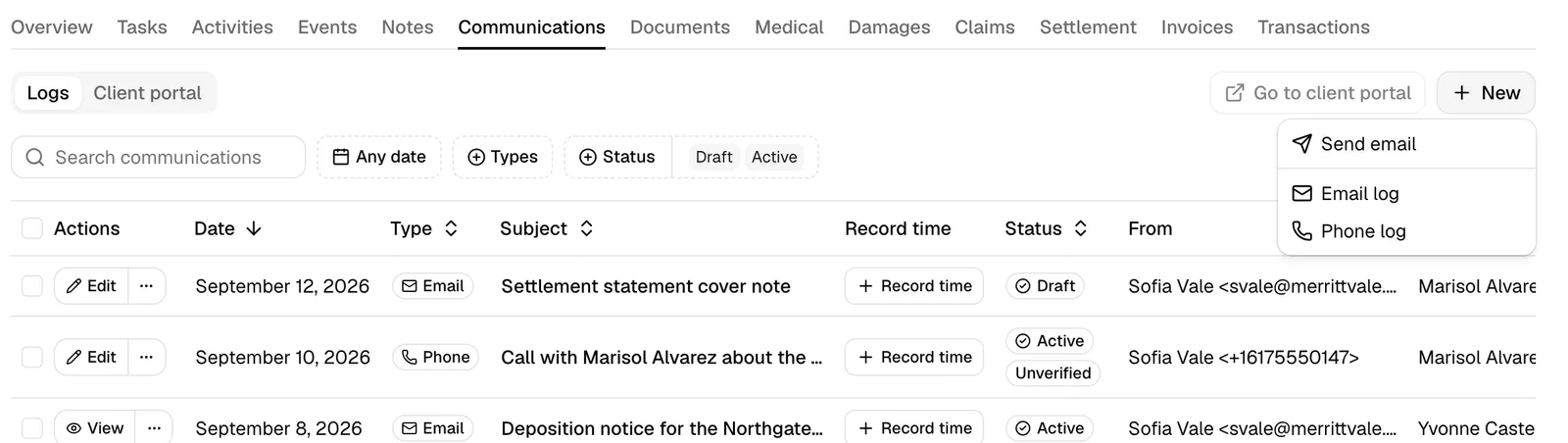
Send an email through your connected mailbox
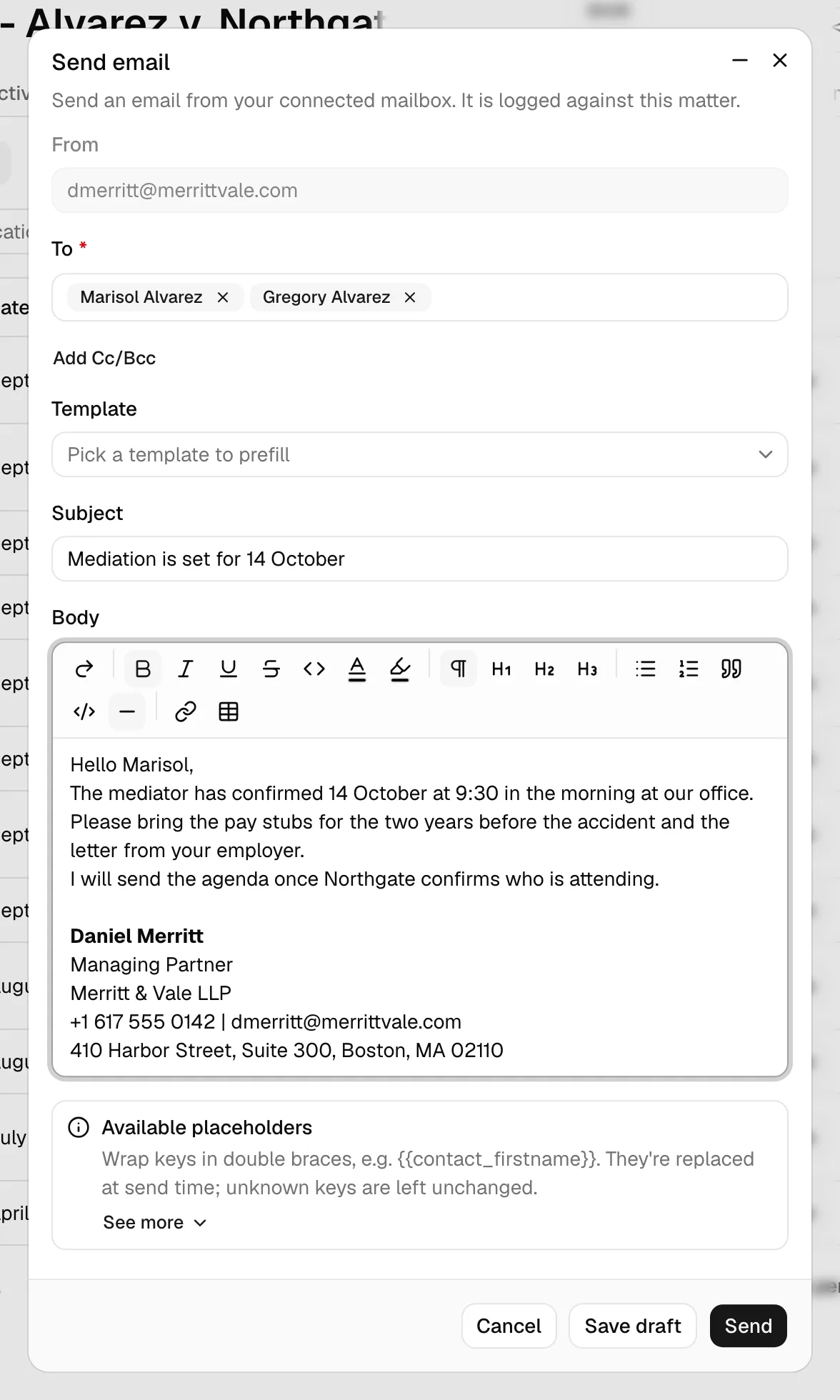
Once the Send email dialog is open, compose your message in the form fields, then send it. The whole message goes out through your own mailbox, so it lands in your real Sent folder and threads normally for the recipient.
- From shows the mailbox the message goes out from. With one connected account it is read-only. With both Gmail and Outlook connected, open the From menu and pick the address you want to send as. See Choosing which mailbox you send from.
- In the To field, add one or more recipients. Click in the field and a list opens with two groups, Members (people at your firm, each shown with their email) and Contacts (your firm's contacts, each shown with the email on their record). You can:
- Pick a member of your firm from the list.
- Pick any contact in your firm from the list. When you opened the composer from a matter or lead, that record's client contacts who have an email are added for you automatically; when you opened it from the header + menu, the To field starts empty so you choose the recipients yourself.
- Type any email address, then press Enter or click the Use '…' option at the bottom of the list to add it. Esqase checks that it looks like a valid email and shows a short hint if it does not. Start typing to filter the list by name or email. Each recipient appears as a removable chip. Click the small x on a chip, or press Backspace in an empty field, to remove the last one.
- To copy other people, click Add Cc/Bcc, then fill in the Cc and Bcc fields the same way. Both accept more than one recipient.
- (Optional) Pick a Template to prefill the subject and body. See Apply an email template.
- In Subject, type the email subject (up to 255 characters). This field is required.
- In Body, write your message using the rich text editor. You can paste images into the body and they go out with the email. Your signature is already inserted at the bottom (see Insert and edit your signature). This field is required.
- Click Send.
While the email is sending, the button shows a spinner and reads Sending.... On success you see a Email sent confirmation, the dialog closes, and the message appears as a new row on the Communications tab with the status Active.
Note: If your subject or body still contains a placeholder that was not filled in when you click Send, Esqase asks you to confirm before the email goes out. See Confirm unfinished placeholders before sending.
Note: Images you paste into the Body are stored securely, and the copy delivered to the recipient links to them. The recipient can view the images for 7 days after you send; the row on the Communications tab keeps showing them for your firm. SVG images are not supported.
Important: Esqase saves the email as a record before it tries to send. If the send fails for any reason, the message is kept as a draft so you can retry it without retyping (see Retry a failed send).
Tip: You can set the composer aside without losing your work. Click the minimize button (the - icon) next to the close (x) button to collapse it into a small bar in the bottom-right corner, then click the bar to bring it back with your draft intact. You cannot minimize or close the composer while it is sending or saving. See Navigating the dashboard.
Choose which matter or lead the email is filed under
The Link to picker appears in two situations: when you open the composer from the header + menu, and when you open it from a contact's detail page. In both cases it lets you decide where the email is logged so it lands on the right record's Communications tab.
When you open the composer from a matter or lead directly, the email is already filed against that record and the Link to picker is not shown.
From the header + menu
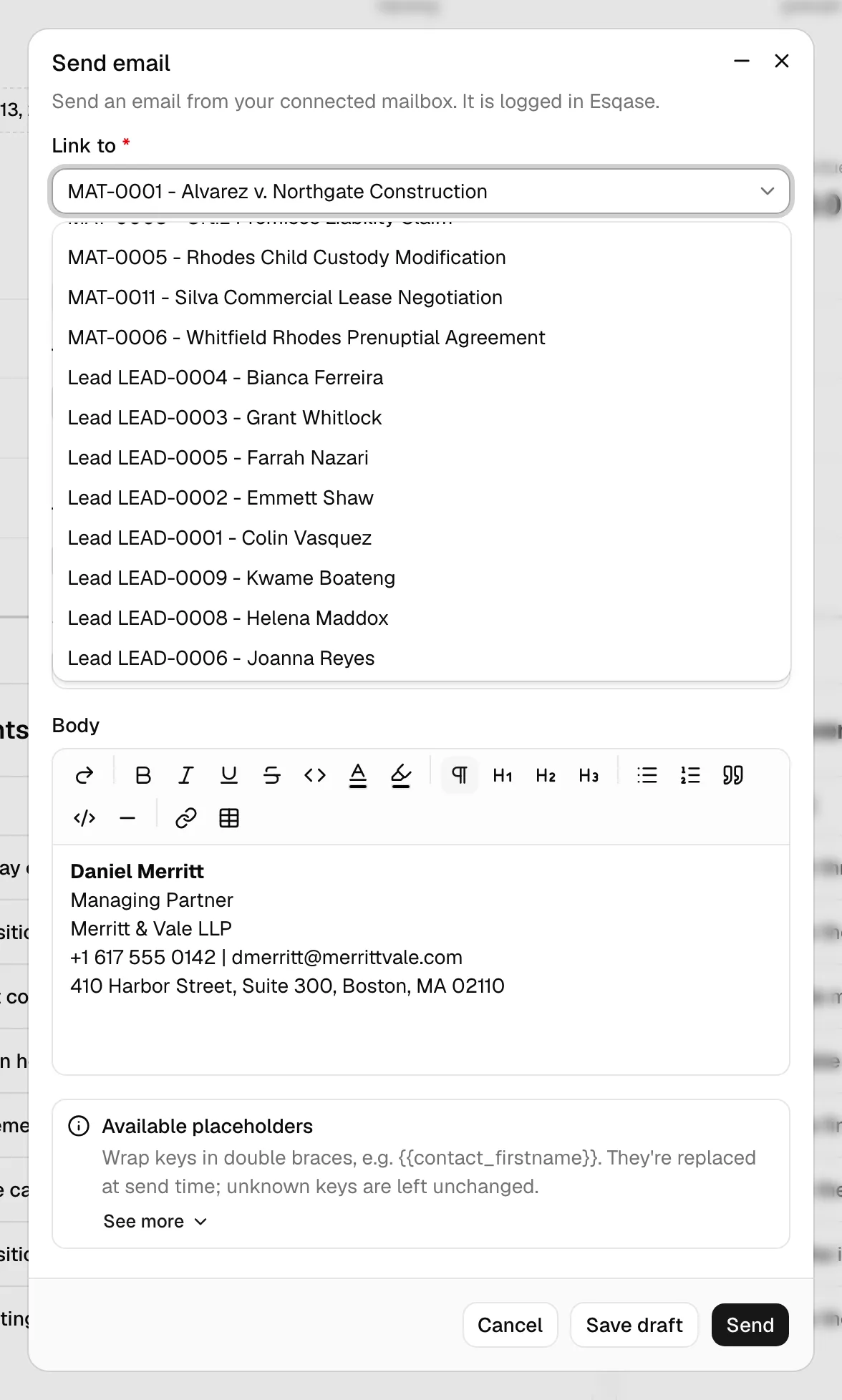
- In the Send email dialog opened from the header + menu, the Link to field is at the very top of the form and is required.
- Open the picker. It lists all of your firm's active matters and open leads.
- Pick the matter or lead you want the email filed under. You must select one before the form will submit.
From a contact's detail page
When you compose from a contact's detail page, the email is not automatically attached to a matter or lead, because a contact can be a client on several matters or tied to more than one lead.
- In the Send email dialog, find the Link to field at the top of the form. It is required when the contact has at least one matter or open lead on file.
- Open the picker. It lists:
- The contact's active client matters, each shown by its number and title, for example 00123 - Acme acquisition.
- The contact's open leads that have not been converted to a matter yet, each shown as Lead followed by its number, for example Lead 00045.
- Pick the matter or lead you want the email filed under. If the contact has exactly one matter (and no open leads), or exactly one open lead (and no matters), that one is selected for you automatically. You can change it.
- If the contact has no matters and no open leads, the Link to field is hidden. The email sends and is logged against the contact, but does not appear on a matter or lead Communications tab.
When you send, the email is logged on the Communications tab of whichever matter or lead you chose, alongside emails sent from that record directly.
Note: If the Link to field does not appear, the contact has no active matters and no open leads yet, so there is nothing to link to. The email still sends and is logged against the contact.
Tip: If you file a contact's email under a lead and that lead is later converted to a matter, the email follows the conversion and appears on the new matter's Communications tab automatically.
What happens to recipients with no email on file
If you pick a contact who has no email address saved (in To, Cc, or Bcc), Esqase shows a No email on file dialog instead of adding them. It tells you the contact has no email and offers a Go to contact link. Open the contact, add an email, then come back and pick the contact again. See Working with contacts.
Apply an email template
A template is a reusable, pre-written email (subject and body) your firm has set up, for example an engagement-letter cover note or an appointment reminder. Applying one saves you from writing the same message twice.
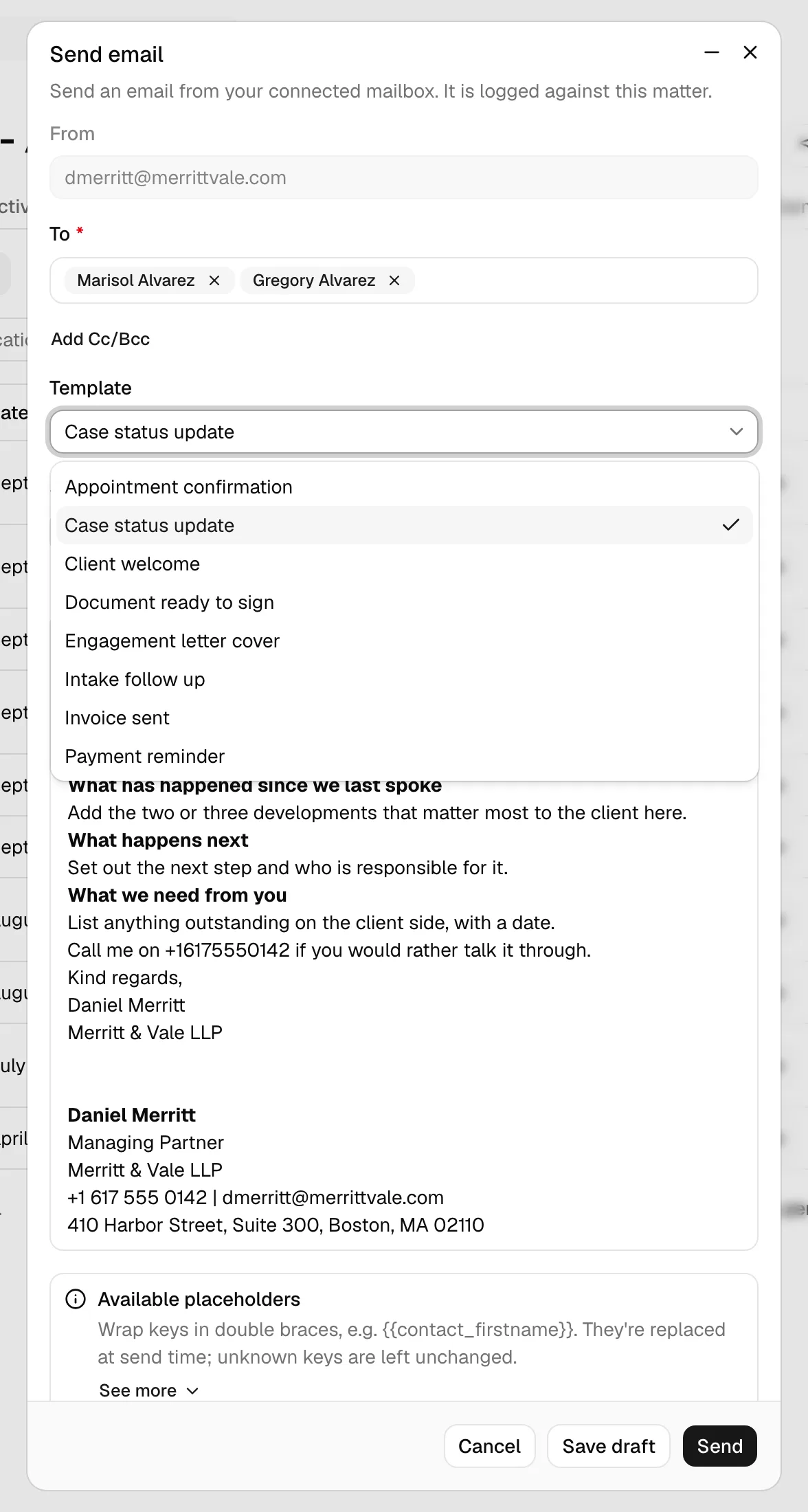
- In the Send email dialog, open the Template field.
- Pick a template from the list. The field is labeled Pick a template to prefill.
- Esqase fills the Subject and Body with the template's content, resolves any placeholders against the current contact, member, firm, and date, and appends your signature.
- Edit the prefilled text however you like.
Note: If you change the subject or body by hand after applying a template, the Template selection clears. That is expected: it just means the message no longer matches the template exactly. Your edits are kept.
Tip: If the Template field reads No templates available, your firm has not created any email templates yet. A firm member with the right access can add them under settings. See Email templates.
Insert and edit your signature
Your email signature (the closing block with your name, firm, and contact details) is added automatically every time you open the composer or apply a template. It is inserted directly into the Body editor, below your message, so you can see and edit it inline before sending.
- The signature is your personal signature if you have set one, otherwise your firm's default signature.
- Placeholders inside the signature (such as your name and the firm address) are filled in for you when it appears in the editor.
- Because the signature lives in the Body field, you can change it for this one email, delete it, or reorder it just like any other text. Editing it here does not change your saved signature.
To change the signature for every future email instead of just this one, update it in your settings. See Email signatures.
Tip: If you do not want a signature on a particular email, simply delete the signature block from the Body before sending.
Use template placeholders
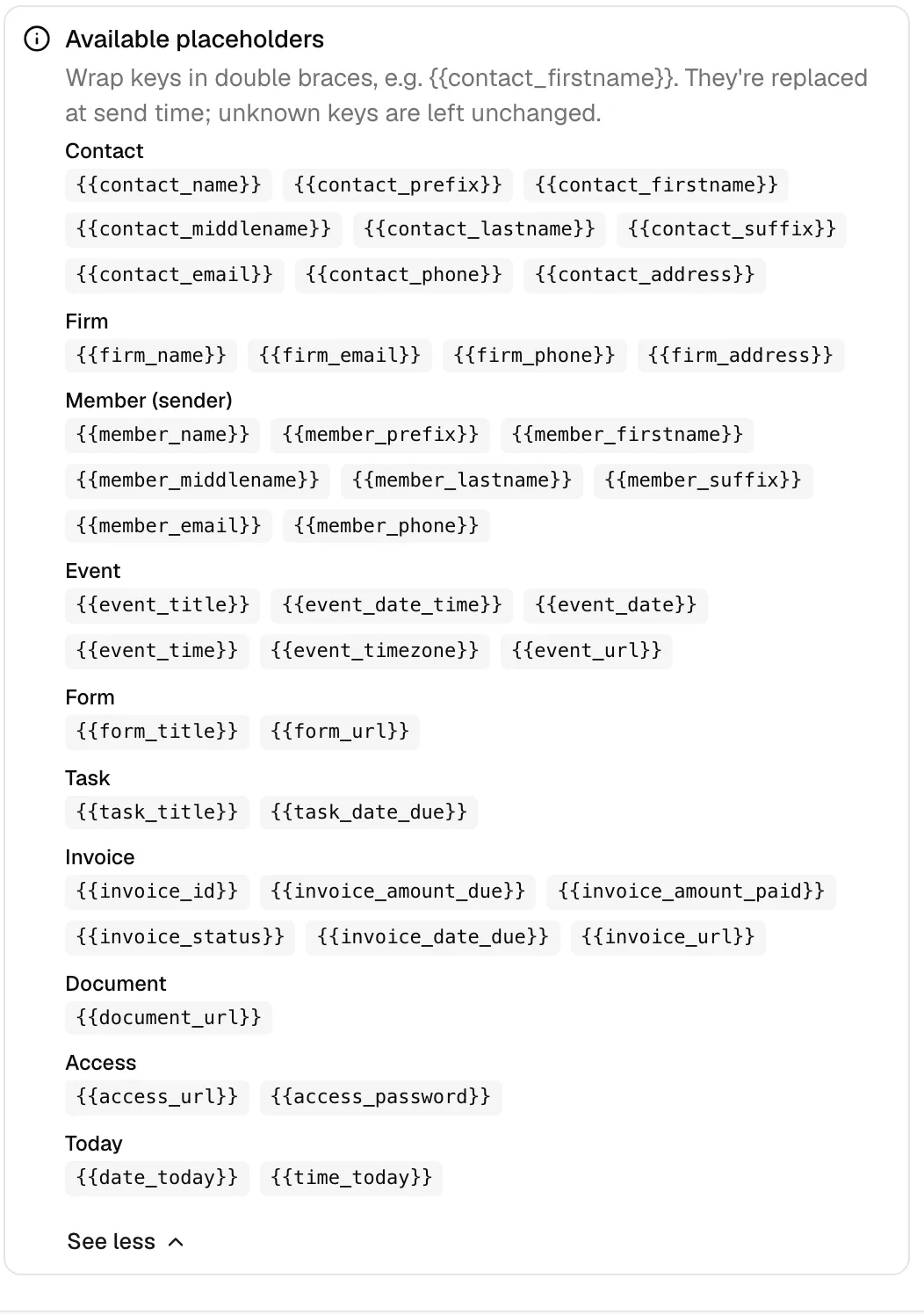
Placeholders are short keys you wrap in double braces, like {{contact_firstname}}. Esqase replaces them with real values at send time so a single template can greet each recipient by name. You can type placeholders anywhere in the Subject or Body.
At the bottom of the composer is an Available placeholders panel. Click See more to expand the full list of keys, grouped by category. Hover any key to see what it inserts.
How placeholders behave:
- Wrap each key in double braces, for example
{{contact_name}}or{{firm_phone}}. - They are replaced when you send (or save a draft, or hand the message off to your own mail app). The recipient never sees the braces.
- If a key has no value (for example, the contact has no phone on file) or the key is misspelled, Esqase leaves it unchanged rather than inserting a blank. When you click Send (or Continue), Esqase warns you about any placeholders that were left unfilled so you can finish them first (see Confirm unfinished placeholders before sending).
- The contact placeholders resolve against the first contact in your To list, falling back to the matter or lead's primary contact.
The most common groups you will use:
- Contact (the person you are writing to):
contact_name,contact_prefix,contact_firstname,contact_middlename,contact_lastname,contact_suffix,contact_email,contact_phone,contact_address.contact_firstnameis built for greetings, so it always resolves to something you can send. Writing to a company contact fills it with the company name; writing to someone recorded with only a full name fills it with that full name. SoHi {{contact_firstname}},reads correctly either way.
- Firm:
firm_name,firm_email,firm_phone,firm_address. - Member (sender), meaning you:
member_name,member_firstname,member_lastname,member_email,member_phone, and more. - Today:
date_today(today's date) andtime_today(the current time).
Note: Other groups (such as Event, Form, Invoice, and Document) appear in the list too. Those keys are filled in only when Esqase sends the email as part of a workflow or scheduling step that has that context. In a plain email you compose by hand, they may be left unchanged.
Confirm unfinished placeholders before sending
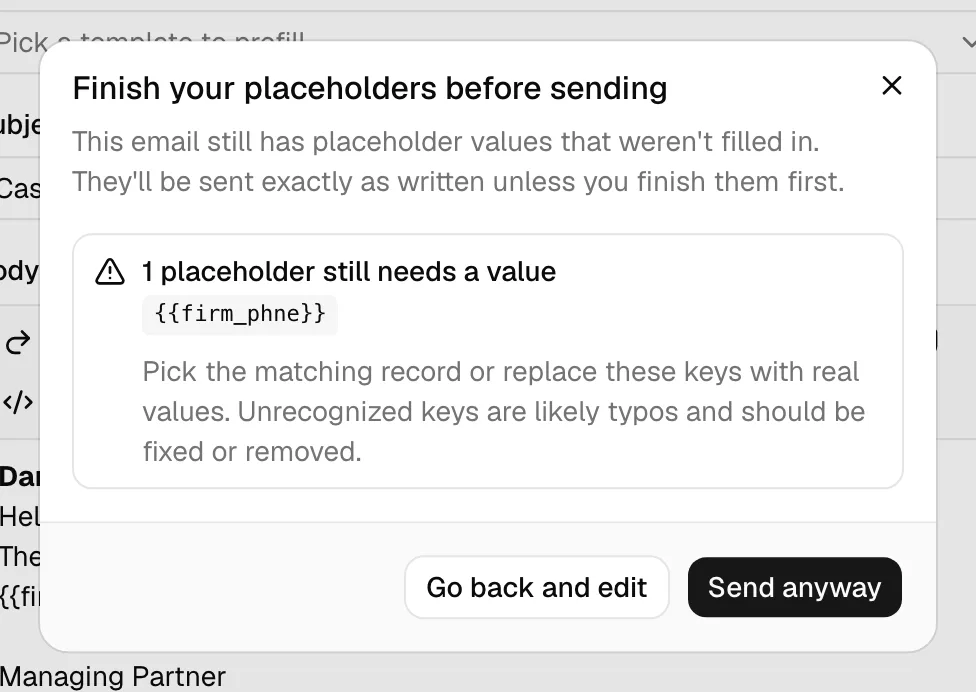
Esqase checks your message when you click Send (or Continue, when no mailbox is connected). If the Subject or Body still contains a placeholder that was not filled in (for example {{firm_address}} when no firm address is on file, or a key with a typo), a Finish your placeholders before sending dialog appears before anything is emailed. It:
- Warns that the email still has placeholder values that were not filled in, and that they will be sent exactly as written.
- Lists each leftover placeholder, such as
{{firm_address}}, so you can see what to fix. - Points out that an unrecognized key is usually a typo you should correct or remove.
You then choose:
- Go back and edit closes the dialog without sending, so you can fill in the value, pick the matching contact, or fix the key, then click Send again.
- Send anyway sends the email as written, leaving the placeholder text in the message. With no mailbox connected, this takes you on to the hand-off step instead of sending.
This check runs only when you click Send or Continue. Saving a draft never shows it, so you can keep unfinished placeholders in a draft and resolve them later.
Save an email as a draft
If a message is not ready to send, save it as a draft and finish it later. Drafts are kept on the Communications tab so you (or a colleague with access) can pick them back up.
- Compose the email as usual: add recipients, a subject, and a body.
- Instead of Send, click Save draft.
The button shows Saving... while it works, then you see a Draft saved confirmation and the dialog closes. The message appears on the Communications tab with the status Draft. Nothing is emailed yet.
Tip: You do not have to fill in everything to save a draft. Save early and often, then come back when you have the missing details.
Note: The Save draft button appears only when you have a mailbox connected. Without one, click Continue and choose Save as draft on the hand-off step instead. See Choose what to record in Esqase.
Open and send a saved draft later
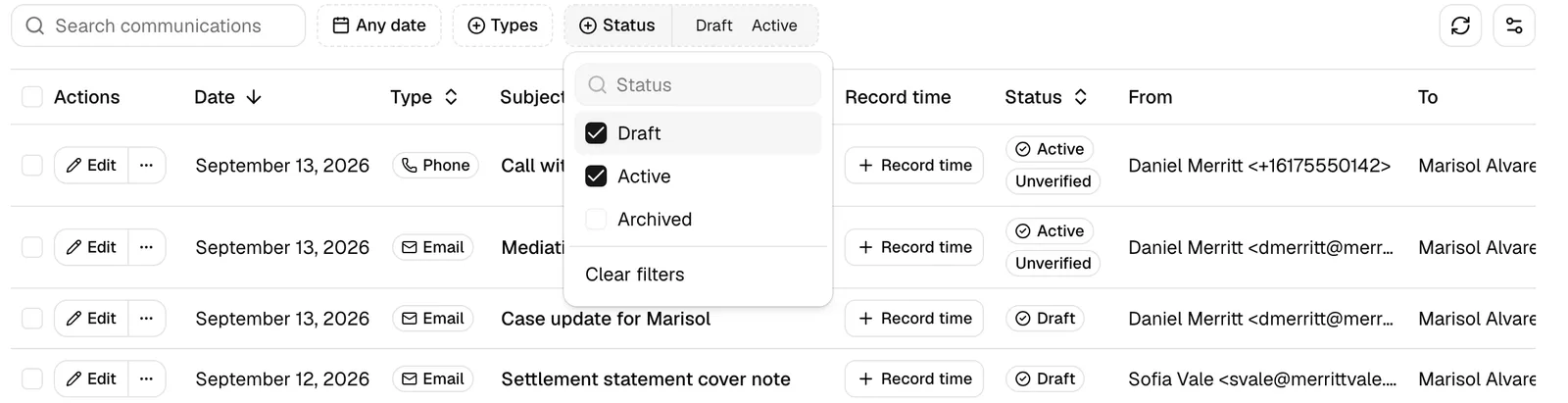
- On the matter's Communications tab, find the row with the Draft status. (Drafts are hidden by the default filter, which shows Active only. Use the Status filter and select Draft to show them.)
- In that row's actions, click Edit. The Send email dialog reopens with the title Edit draft email and your saved recipients, subject, and body restored.
- Make any final changes.
- Click Send to send it now, or Save draft again to keep editing later.
Retry a failed send from a saved draft
Because Esqase saves the email record before contacting your mailbox, a failed send never loses your work. If the send fails, you see a message telling you the draft was saved so you can try again, and the message is kept as a Draft on the Communications tab.
To retry:
- Open the matter's Communications tab.
- Show drafts using the Status filter (select Draft), then find the failed message.
- Click Edit to reopen it in the Send email dialog.
- Confirm the recipients, subject, and body still look right.
- Click Send again.
If the send succeeds this time, the row flips from Draft to Active and the email goes out.
Note: A common reason a send fails is that your mailbox connection has expired or been revoked. If retries keep failing, reconnect Gmail or Outlook on the Integrations page, then try again. See Connecting Google (Gmail, Calendar, Meet) and Connecting Outlook and Zoom.
Send from your own mail app (no mailbox connected)
You do not need a connected mailbox to use the composer. Write the message here exactly as you normally would, and Esqase hands the finished message to whichever mail app you use, with the placeholders already filled in.
At the top of the form you will usually see a No mailbox connected notice. It explains that you can compose here and hand the message off to your own mail app, and that connecting a mailbox lets you send directly from Esqase and log delivery automatically. The notice names only the mailboxes you can actually connect, so it reads Connect Gmail or Outlook, Connect Gmail, or Connect Outlook, and those words link to the Integrations page. If neither Gmail nor Outlook is available to connect, the notice is not shown at all, because there would be nothing to set up. Everything else in the composer works as described above: recipients, template, subject, body, signature and placeholders.
Important: Esqase can confirm delivery only for messages it sends itself. A message you finish in your own mail app leaves Esqase's hands, so anything you record about it is your own note that it went out. See Choose what to record in Esqase.
Hand the message off
- Fill in the composer as usual.
- Click Continue (this is where the Send button sits when a mailbox is connected). If any placeholders are unfilled, Esqase asks you to confirm first.
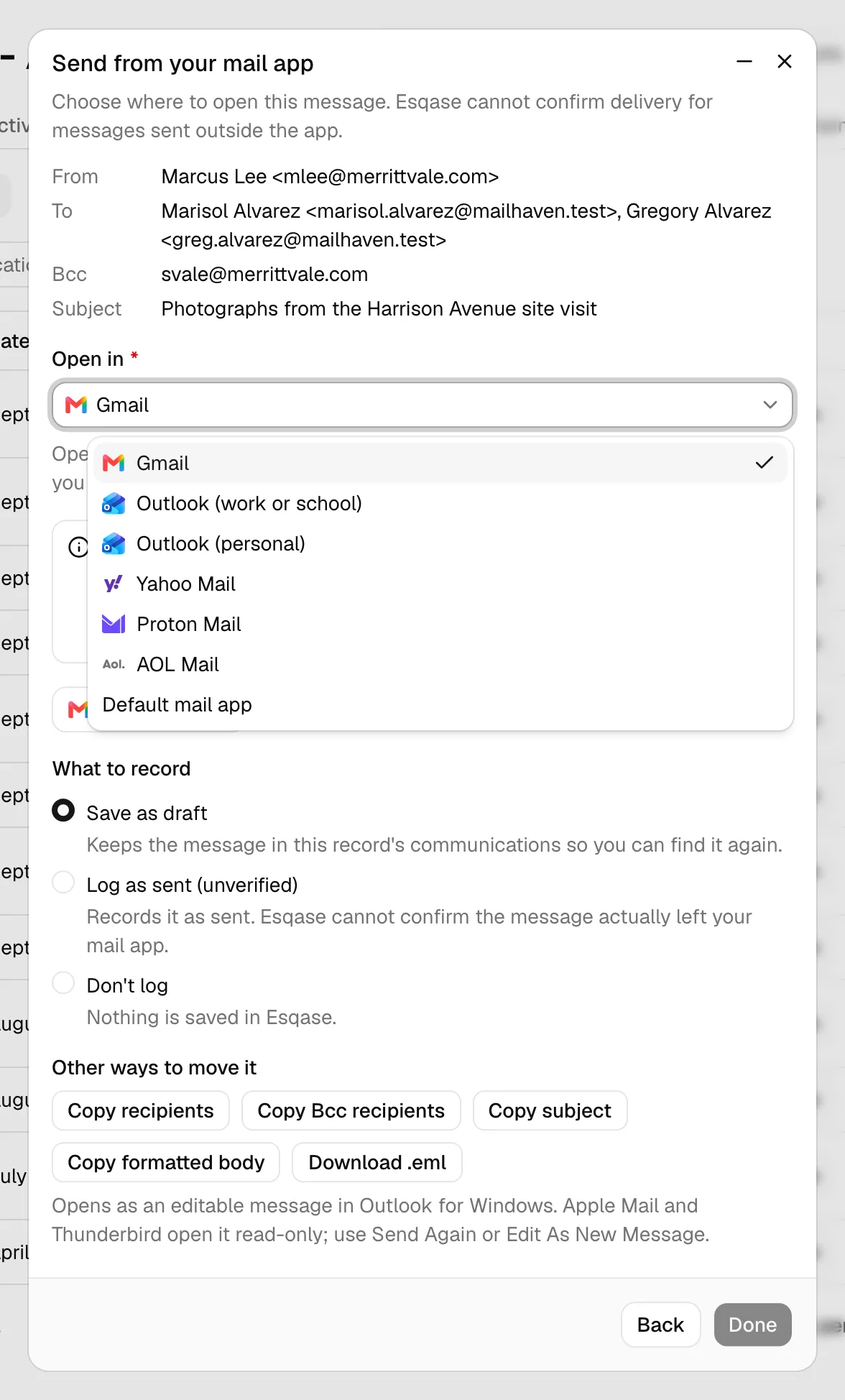
- The dialog moves to a second step titled Send from your mail app. At the top it recaps From, To, any Cc and Bcc, and the Subject, so you can check the message before it leaves.
- Open the Open in picker and choose where to write the message. The options are Gmail, Outlook (work or school), Outlook (personal), Yahoo Mail, Proton Mail, AOL Mail, and Default mail app (whichever mail app this computer is set to use). A short line under the picker explains what to expect from the option you chose.
- Click the open button, for example Open in Gmail, or Open your default mail app. Your mail app opens with the recipients, subject and message already filled in. Review it there and send it yourself.
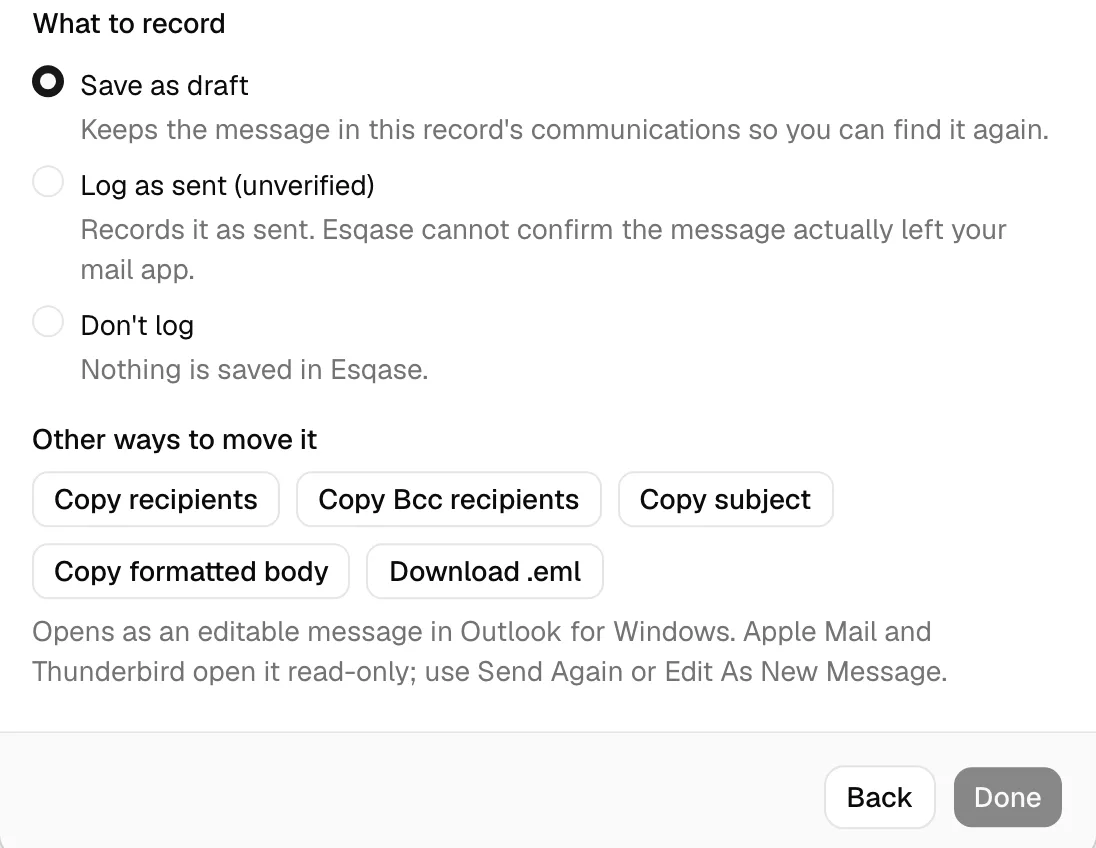
- Back in Esqase, choose What to record, then click Done.
Note: Done stays inactive until you have actually moved the message somewhere: opened it in a mail app, or used one of the copy or download buttons. That way you cannot record an email you have not sent.
Tip: Prefer Outlook (work or school) for a company or university account and Outlook (personal) for an Outlook.com, Hotmail, or Live address. Choosing the wrong one lands on an account picker and the prefilled message is lost.
Keep the formatting, images, and Bcc
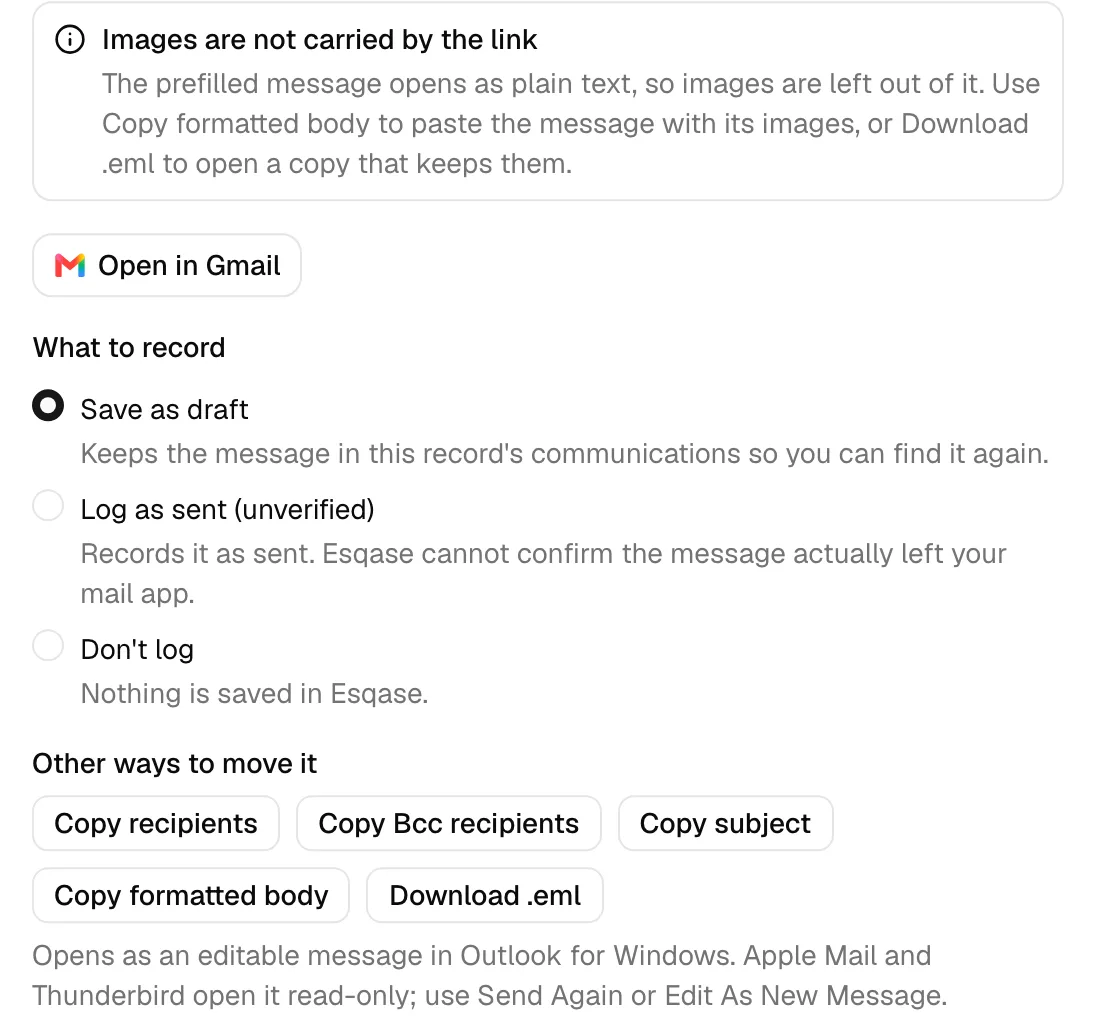
A prefilled link can only carry plain text, so the copy that opens in your mail app is simplified. The step gives you three ways to move the rest across, under Other ways to move it:
- Copy formatted body puts the formatted version of your message on the clipboard. Paste it over the plain text in your mail app to restore the styling and any images.
- Download .eml saves the message as a file that keeps the formatting, the images, and the recipients. Open the file in your mail app and send it from there. A line under the buttons explains how each mail app treats the file: it opens as an editable message in Outlook for Windows, while Apple Mail and Thunderbird open it read-only, so use Send Again or Edit As New Message there.
- Copy recipients, Copy Bcc recipients (shown only when you added Bcc), and Copy subject put those details on the clipboard so you can paste them in by hand.
Esqase tells you when something could not travel in the link:
- Too long for a prefilled link. Your message is longer than the mail app you chose can accept, so the copy that opens there is cut short. Use Copy formatted body or Download .eml to move the whole message.
- Bcc is not carried by the link. Your Bcc recipients were left out. Use Copy Bcc recipients and add them in your mail app.
- Images are not carried by the link. The prefilled message opens as plain text, so images in your body are left out. Use Copy formatted body to paste the message with its images, or Download .eml to open a copy that keeps them.
Choose what to record in Esqase
Before you finish, pick what should be kept on the Communications tab under What to record:
- Save as draft (the default) keeps the message in this record's communications so you can find it again. It appears with the Draft status.
- Log as sent (unverified) records it as sent. Esqase cannot confirm the message actually left your mail app, so the row is marked Unverified on the Communications tab.
- Don't log saves nothing in Esqase.
Click Done to finish. You see a Draft saved or Email logged as sent confirmation and the dialog closes.
Important: An Unverified row is your own record that you sent the message, not proof of delivery. Esqase never sees the message once it is in your mail app, and replies to it are not pulled back in. Connect Gmail or Outlook if you want delivery recorded for you.
Go back to the composer
Click Back in the dialog footer to return to the compose form. Everything you typed is still there, so you can fix the subject, add a recipient, or edit the message and click Continue again.
Signature requests get one message per signer
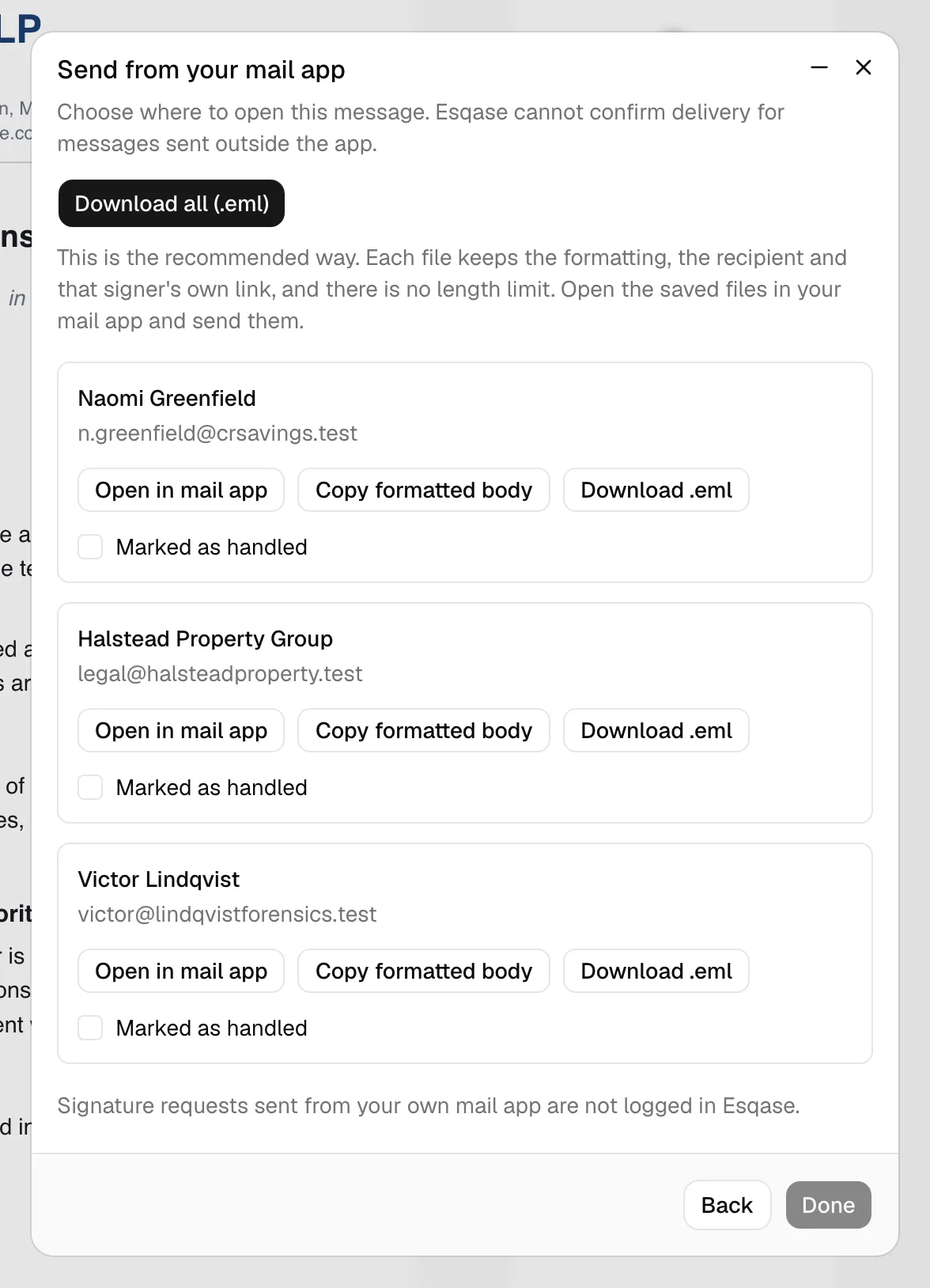
The Send to signers flow on a document is different, because every signer receives their own personal signing link. With no mailbox connected, the hand-off step lists each signer separately instead of showing a single message.
- Download all (.eml) is the recommended action. It saves one file per signer, each keeping the formatting, that person's address, and that person's own signing link, with no length limit. Open them in your mail app and send them.
- Each signer's row also has Open in mail app, Copy formatted body, and Download .eml for that one message, plus a Marked as handled checkbox so you can keep track. Done becomes available once you have marked at least one signer as handled.
- If a signer's message is too long for a mail app link, the row says so and points you to the download instead, so the signing link is never cut off.
- These messages are not logged in Esqase, and the step says so. There is no What to record choice here.
- If the document still needs approval, no signing links are shown at all. You see a This document needs approval notice instead. Get the approval done, then reopen the step.
For the full signature flow, see Requesting eSignatures.
Emails Esqase sends for you also appear on Communications
Beyond the emails you write in the composer, Esqase sends a few emails on your behalf as part of other flows. When one of those emails relates to a matter or lead, it is recorded on that record's Communications tab too, so the tab shows the full picture of what your client has been sent. You do not have to do anything: these rows appear on their own and are read-only.
These automatic rows cover:
- Invoice payment notices. When you email a client a payment link from an invoice, the message is filed on that invoice's matter. See Creating and sending invoices.
- Document share links. When you share a document with a specific recipient, the secure link is emailed to them and recorded on the document's matter. See Sharing documents.
- Signature request links. When you send a document for signature, each outside signer's signing link is emailed to them and recorded on the matter. See Requesting eSignatures.
- Booking and payment sign-in links. When a client asks for a secure sign-in link to open a booking page or a payment link, that email is recorded on the related matter or lead.
Note: These rows behave like any other sent email on the tab: they are read-only, show the Email type, and can be searched and filtered along with everything else. They appear only when the email is connected to a matter or lead.
Common questions
Where do sent emails go after I send them? Each email becomes a row on the Communications tab of the matter or lead it is filed under, with the Email type. When you send from a contact, that is whichever matter or lead you chose in the Link to picker. Emails sent through a connected mailbox are read-only there. Replies arrive in your own inbox. Through Outlook they are recorded on the same record automatically; through Gmail you add them yourself with Email log, because the Gmail connection is send-only.
Do I have to connect Gmail or Outlook to email a client? No. The composer always opens, and without a connected mailbox you finish the send in your own mail app. Connecting one is still worth it: Esqase then sends the message for you, records it as genuinely sent, and (with Outlook) threads client replies back onto the record.
Why does the button say Continue instead of Send? You have no mailbox connected, so Esqase cannot send the message itself. Continue takes you to the hand-off step where you choose which mail app to open it in. See Send from your own mail app.
What does the Unverified badge mean? You chose Log as sent (unverified) after handing a message off to your own mail app. Esqase kept your record of it, but never saw the message go out, so it does not claim the email was delivered.
Why did my formatting disappear in Gmail (or Outlook) after the hand-off? A prefilled link can only carry plain text. Use Copy formatted body and paste over the plain version, or Download .eml and open that file instead. See Keep the formatting, images, and Bcc.
I sent an email from the header + menu (or from a contact). Why did it ask me what to link it to? When there is no specific matter or lead already in scope, Esqase cannot guess which record the email belongs to. The Link to picker lets you choose, or you can leave it Not linked to a matter or lead. When composing from a contact, the picker shows only that contact's matters and leads. From the header +, it shows all active firm matters and open leads. See Choose which matter or lead the email is filed under.
Can I edit an email after I send it? An email sent through a connected mailbox becomes read-only in Esqase, so you can only View it, not edit it. Drafts stay editable, and so does a message you logged after handing it off to your own mail app, since Esqase only holds your own record of it. To follow up on a sent email, send a new one.
Why is the From field locked? With a single mailbox connected, Esqase sends as you from that account, so From is fixed to it. Connect a second mailbox and From becomes a picker. With no mailbox connected, From shows your Esqase sign-in address purely to label the record, because your mail app decides the real sending address.
Someone added a contact's email after I started. Do I need to start over? No. Close the No email on file notice, add the email on the contact, then reopen the composer and pick the contact again.
Why did Esqase ask me to confirm placeholders when I clicked Send?
Your message still had a placeholder that was not filled in, such as {{firm_address}} with no value on file or a key with a typo. Esqase pauses so the braces do not go out by accident. Choose Go back and edit to fix it, or Send anyway to send it as written. See Confirm unfinished placeholders before sending.
Troubleshooting
- I don't see a New button or a Send email option. Your role may not include Create access for communications, or you may not have permission to view the Communications tab. Ask a firm owner or administrator to adjust your role. See Roles and permissions.
- The composer shows a "No mailbox connected" notice. That is expected when neither Gmail nor Outlook is linked. You can still compose and hand the message off, or click the connect link in that notice to link a mailbox and send directly. If you see no notice at all and the button still reads Continue, neither mailbox is available to connect in your Esqase environment, and handing the message to your own mail app is the intended way to send it.
- My mail app opened empty, or without the message. The link may have been too long for that mail app, or the app may have been slow to start. Use Download .eml to open the whole message as a file instead, or Copy formatted body and paste it in.
- The Done button is greyed out on the hand-off step. Open the message in a mail app, or use one of the copy or download buttons, first. On a signature request, tick Marked as handled on at least one signer.
- My placeholder did not get replaced. The key may be misspelled, or the underlying value may be empty (for example, the contact has no phone). Esqase leaves unknown or empty keys as-is. Open Available placeholders, click See more, and copy the exact key. When you click Send or Continue, Esqase also lists any leftover placeholders so you can fix them before the email goes out.
- A dialog asked me to finish my placeholders. Your message still has a placeholder that was not filled in. Choose Go back and edit to fix it, or Send anyway to send the message as written. See Confirm unfinished placeholders before sending.
- The Template field says "No templates available." Your firm has no email templates yet. See Email templates.
- The send failed. Your message was saved as a draft. Reopen it from the Communications tab (filter by Draft), click Edit, and click Send again. If it keeps failing, reconnect your mailbox.