Available lang sa Ingles ang dokumentasyon ng produkto.
Torts and damages (Philippines)
When your firm's registered country is the Philippines, the personal injury module arrives configured for Philippine practice. It is called Torts and Damages, a statute of limitations is a Prescriptive period, a lien is a Claim against recovery, and the case types, damage heads, insurance kinds, record requests and deadline suggestions are the Philippine ones.
Everything else works exactly as the rest of this section describes. This page covers only what is different, and what Esqase suggests when you fill a field in.
Important: The figures, periods and notes below are reference defaults Esqase puts in front of you, not legal advice and not rules the product enforces. Every one of them can be changed on the record you are filling in. Check each against the file and the current law before you rely on it.
Before you begin
- Personal injury is part of the Professional plan. On the Standard plan the module is hidden: the Torts and Damages group is not in the sidebar and matters do not show the personal injury tabs. Only the firm owner can move the firm to Professional, from Settings > Billing. See Your Esqase subscription.
- Your firm owner also accepts a compliance agreement once. A Philippine firm is offered the Data Processing Agreement, never the business associate agreement. Until it is accepted the module opens on a Data Processing Agreement required card and nothing can be recorded. See Compliance agreements (BAA and DPA).
- Your firm's registered country is what switches this on, not your language, your browser, or where you happen to be sitting. It is set on your firm profile. See Your firm profile and details.
- The permissions are the same as everywhere else in the module: Personal injury and Medical records and bills. See Personal injury overview.
What is named differently
| What a firm elsewhere sees | What a Philippine firm sees |
|---|---|
| Personal injury | Torts and Damages |
| Track as personal injury | Track as torts and damages |
| Case type | Cause of action |
| Statute of limitations | Prescriptive period |
| Statute of limitations date | Prescriptive period end date |
| Statute of limitations at risk | Prescriptive periods at risk |
| Statute (matters table column) | Prescription |
| Liens | Claims (sidebar), Claims against recovery (the record itself) |
| Liens and balances | Claims and balances |
| Lien aging (report) | Claim aging |
| Advanced case costs | Advanced litigation expenses |
| Contingency | Contingent fee |
| Default contingency rate | Default contingent fee rate |
| Personal Injury (practice area) | Torts and Damages |
The four tabs on a matter keep the same names in both: Medical, Damages, Claims, and Settlement. So do the pages under the sidebar group, apart from Claims: Overview, Records, Settlements, Deadlines, and Reports.
Cause of action
On the Medical tab, the Incident details card's case field is labelled Cause of action. Alongside the general types (motor vehicle, premises, medical malpractice and the rest), a Philippine firm gets four Philippine tracks:
- Quasi-delict (Art. 2176), the default route for a road or premises injury.
- Breach of contract of carriage, available where your client was a paying passenger.
- Reckless imprudence with civil action, where the criminal case is running.
- Employees' compensation, where the claim goes to the System.
Pick one and Esqase shows a short panel underneath explaining what the track means for the case, with a warning in red where the choice costs you something. Choosing Breach of contract of carriage, for example, warns that a surviving passenger who pleads it instead of quasi-delict loses moral damages, with the exceptions named.
The same card's Client fault share field carries a Philippine note: contributory negligence reduces the recovery, and reported apportionments run from 20 to 50 per cent.
Note: The panel is guidance on the form, not a filter. Choosing a track does not hide anything elsewhere in the case.
Prescriptive periods
The suggestion picker
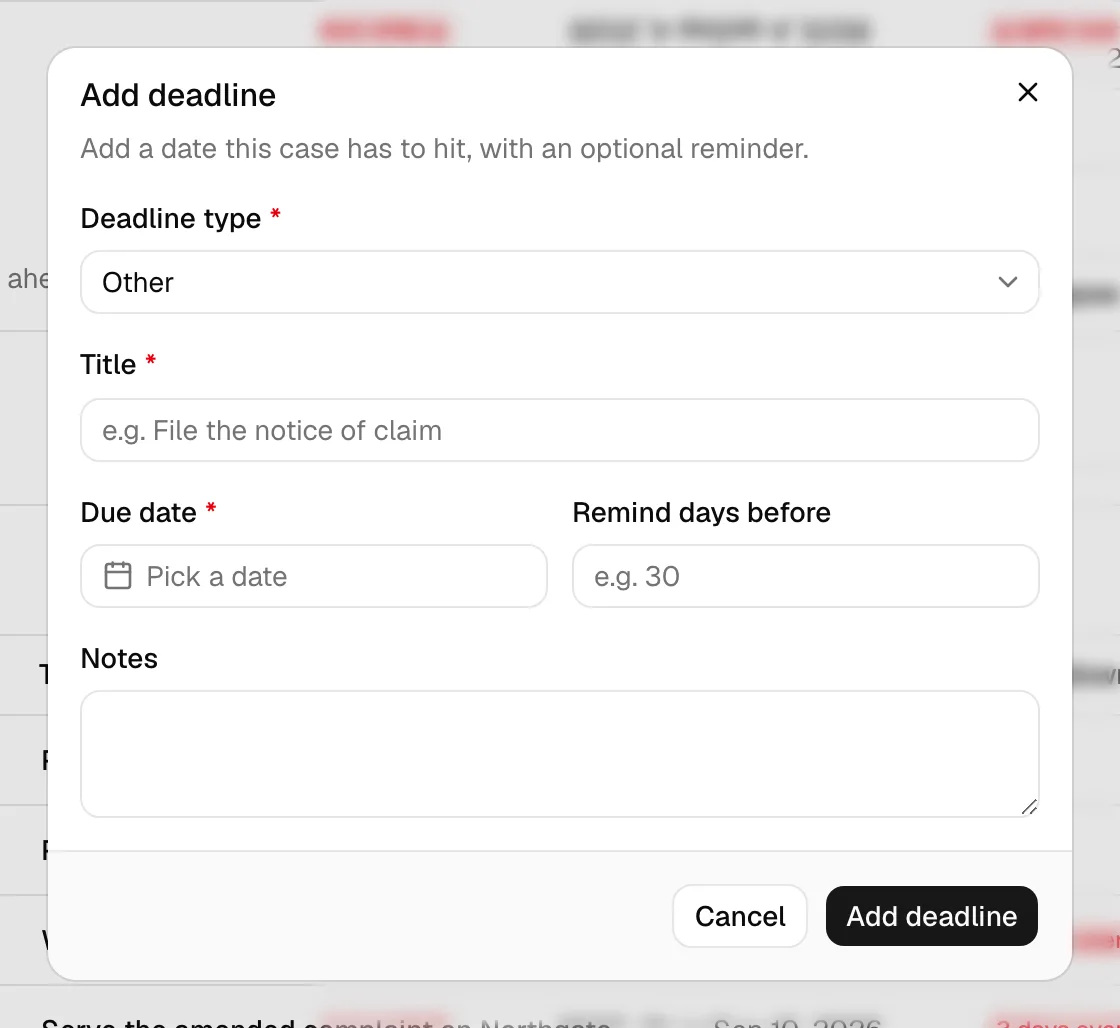
When you add a deadline on the Claims tab, a Philippine firm gets an extra field at the top of the dialog: Start from a prescriptive period, with the placeholder Pick an entry from the pack. It is a searchable list of 18 Philippine periods, from Quasi-delict, 4 years through the criminal prescription entries, the Insurance Code windows, barangay conciliation, the employees' compensation and labour periods, and two practice reminders.
Pick one and Esqase fills in four things at once:
- The Deadline type.
- The Title, for example "Prescriptive period, quasi-delict".
- The Remind days before value.
- The Due date, counted from the anchor the entry uses.
The date is only filled in when the matter already carries the anchor it counts from. Under the date field you get one of three hints:
- Suggested from the pack. Confirm the date against the file. when Esqase worked the date out.
- Add the date of the incident to compute this date. (or the anchor the entry needs) when that date is not on the case yet.
- Set the date from the date the demand was received. for the one entry that has no fixed period.
The hint clears as soon as you type a date yourself.
Important: The picker appears only when you are adding a deadline, not when you edit one, and only for a Philippine firm.
What the picker tells you
While a suggestion is selected, a panel under it shows the entry's name, an explanation of the period, and its citations listed as text. Where the entry carries a caution it appears in red under the explanation. Some of them matter a great deal in practice, for example:
- Prescription runs against a minor who has parents or a guardian, so there is no minority tolling.
- Filing the criminal case does not stop the clock on a separate quasi-delict action, so both need tracking.
- Barangay conciliation suspends the clock for up to 60 days. It does not restart it, and days already run are not given back.
- Reckless imprudence resulting in slight physical injuries prescribes in two months and cannot be complexed with another count.
Several entries say plainly where the law is unsettled, including the standalone period for civil liability arising from the crime and whether a written demand interrupts the quasi-delict period.
Damage heads
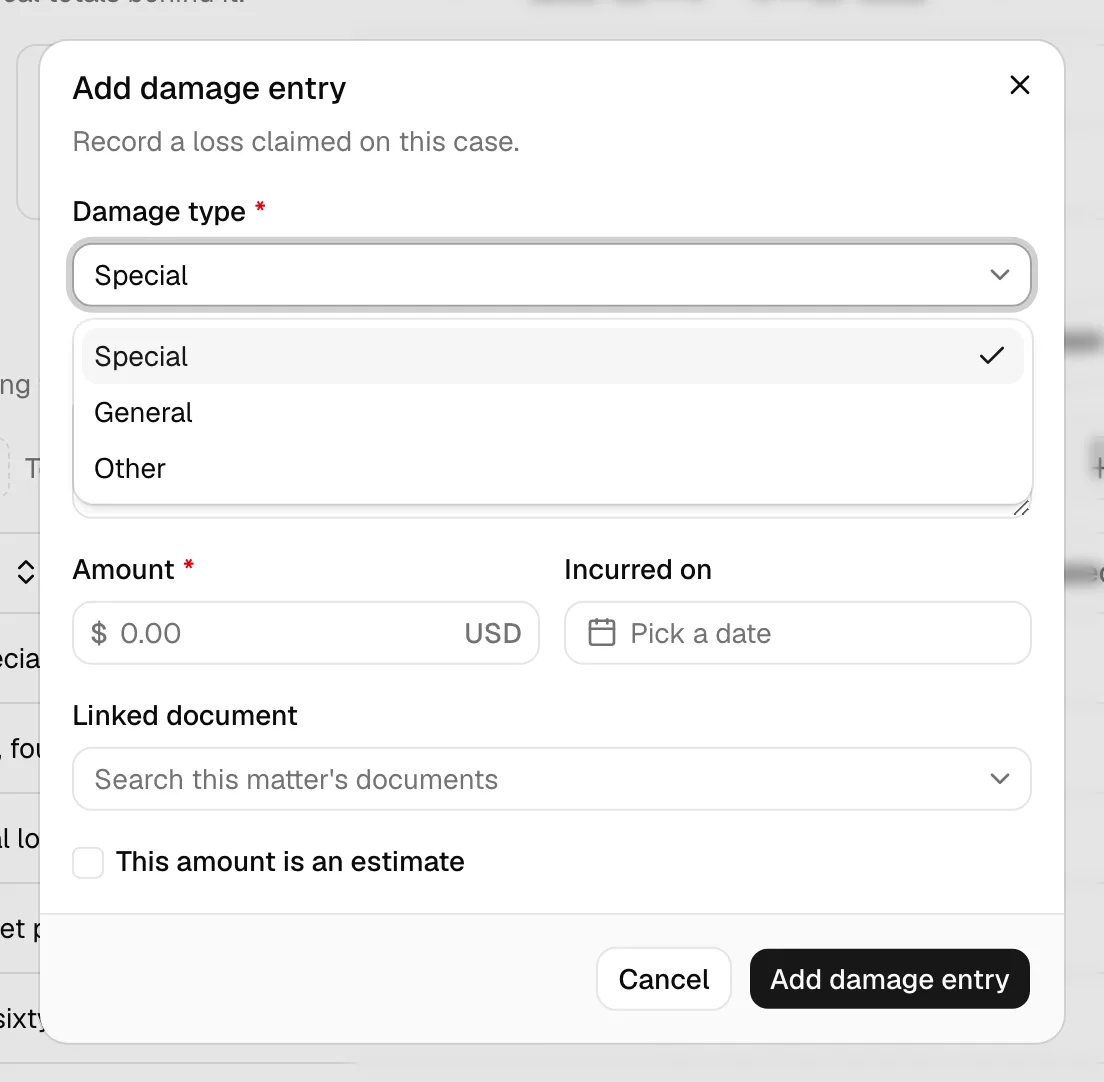
On the Damages tab, the damage type list is the Civil Code set: Actual and compensatory, Loss of earning capacity, Civil indemnity for death, Moral, Exemplary, Temperate, Nominal, Liquidated, Attorney's fees and litigation expenses, and Other.
Choose one and a panel opens under the field with four things: what the head covers, what has to be proved, a red caution where there is one, and the citations as text. So Exemplary reminds you that entitlement to moral, temperate or compensatory damages comes first, and Attorney's fees and litigation expenses warns that this is the fee the losing party is ordered to pay, which is a different thing from the fee your client owes your firm.
Two heads carry a reference amount and a button that fills it in:
- Civil indemnity for death: Use the reference amount (₱300,000.00).
- Temperate: Use the reference amount (₱50,000.00).
Under each button a caption reads Reference default, editable. and names the basis for the figure.
Note: The reference amounts are always shown in pesos. If the matter is billed in another currency, the button is disabled and the caption says the entry is recorded in that currency, so the figure is not filled in for you. Type the amount yourself.
The loss of earning capacity helper
Choose Loss of earning capacity on a Philippine firm and a calculator opens under the panel, headed with the same caution: the life expectancy formula is a death formula, so never apply it to a claimant who survived.
The checkbox The claimant died switches the calculator between two modes.
With it ticked (a death case), enter:
- Age at death.
- Gross annual income.
- Living expenses %, which starts at 50.
Two lines show the working as you type: life expectancy at two thirds of 80 less the age at death, then that figure multiplied by gross annual income less the living-expenses share.
With it unticked (a living claimant), enter:
- Gross monthly income.
- Months unable to work.
- Leave or clear Deduct 50% for living expenses, which starts ticked. Its note says courts have gone both ways on the deduction for a living claimant.
One line shows the working.
Click Use this amount to put the result in the Amount field. If the Description field is still empty, Esqase writes the worked line into it as well, so the arithmetic travels with the entry. If you have already written a description, it is left alone.
Insurance and the CTPL helper
On the Claims tab, the policy type list is the Philippine one:
- CTPL (compulsory third party liability)
- Voluntary third party liability
- Comprehensive motor
- Passenger accident (PUV)
- HMO
- Health
- Employees' compensation (ECC)
- Commercial general liability
- Other
The auto liability, uninsured and underinsured motorist, MedPay, personal injury protection, homeowners and umbrella types other countries see are not offered.
Choose CTPL and a helper panel opens under the field. It covers the parts of the compulsory cover that decide whether a claim survives:
- Every registered vehicle must carry it, and the liability limit is a reference figure set by circular rather than by statute, so read the policy schedule.
- The no-fault indemnity can be claimed without proving fault, with a statutory floor and a higher current circular figure.
- The claim lies against one insurer only, and your client does not choose which.
- Proof of loss is a closed statutory list, under oath.
- The no-fault payment comes out of the same policy limit rather than sitting on top of it.
- An insurer may not require a quitclaim as a condition of paying no-fault.
- Notice of claim has to reach the insurer within six months of the accident, with a physician certification, and suit follows within a year of the first written denial.
- Not everyone is a third party: a member of the owner's household, a relative within the second degree, and an employee injured in the course of employment all fall outside the cover.
The panel closes by telling you to record the no-fault claim deadline on the Deadlines section of the Claims tab, and offers Use the reference limit (₱200,000.00) to fill in the per-person limit. As with the damage amounts, the reference limit is always shown in pesos, and the button is disabled when the policy is recorded in another currency or the limit is already filled in.
Claims against recovery
What a firm elsewhere records as a lien, a Philippine firm records as a Claim against recovery. The Claim type list is the Philippine one:
- Attorney's lien
- Hospital promissory note
- HMO reimbursement
- PhilHealth benefit
- SSS benefit
- GSIS benefit
- Employees' compensation (ECC)
- Employer advance
- Medical provider
- Other
The American types (health plan subrogation, ERISA, Medicare, Medicaid, hospital statutory liens, letters of protection, litigation funding, child support) are not offered.
Picking a type sets the record's kind for you on a new claim, choosing between Claim against recovery and Outstanding balance, and opens a panel explaining what the claim actually rests on. The panel is blunt about it: only the attorney's charging lien is a lien in Philippine law, an unpaid provider bill is an ordinary debt of the client, and a PhilHealth, SSS or GSIS benefit is recorded for the picture only.
The Statutory basis field gives you a placeholder suited to the type you picked, so an attorney's lien suggests the CPRA canon and a hospital promissory note suggests the section of the statute it rests on. You can type anything you like over it.
Important: SSS, GSIS and employees' compensation benefits cannot be attached, and a fee cannot be deducted from them. When you record a recovery on the Settlement tab, the amount field says so. Do not enter one of those benefits as a settlement recovery.
Records you can request
On the Medical tab, What was requested offers the Philippine documents alongside the general ones:
- Medico-legal certificate
- PNP traffic accident investigation report
- Barangay blotter
- Certificate to File Action
- PSA death certificate
- Income proof (ITR or employer certification)
- plus Records, Bills, Imaging, Film, and Affidavit
Each option carries a one-line note under it in the list, for example that the medico-legal certificate's classification of the injuries decides the criminal charge and therefore how fast the criminal case prescribes, or that a Certificate to File Action is only needed where both parties are natural persons actually residing in the same city or municipality.
Note: Medical records are sensitive personal information. The Records option says so and reminds you to get the client's written consent on the authorization before requesting them, and to keep the signed authorization on the file.
Settlement defaults and the starter pack
Settings > Torts and Damages is the same page as everywhere else, with Philippine defaults. See Personal injury settings.
- Default contingent fee rate is described as "Applied to a new legal fee. Members can change it per case. A contingent fee must be fair and reasonable and can be reduced by a court." Installing the starter pack seeds 30 per cent if your firm has not set a rate.
- Statement acknowledgment is seeded with Philippine wording covering the compromise, its effect between the parties, and that it does not extinguish a criminal action arising from the same incident. It only fills a blank field, so anything your firm has already written is left alone.
- The starter pack installs field sets, a matter template, an intake form, and a task list, all named for torts and damages. The field sets add Philippine fields such as Barangay, Police report or blotter number, Citation issued, Public utility vehicle, Criminal case number, CTPL policy number, and HMO. The intake form asks about the barangay, a promissory note before discharge, and PhilHealth membership. The task plan includes filing the notice of claim with the insurer and reviewing the prescriptive period.
Two more Philippine notes appear on the Settlement tab itself:
- When you move a settlement to Agreed, a line reminds you that a compromise for a minor or an estate needs court approval.
- The recovery amount field carries the warning about SSS, GSIS and employees' compensation benefits described above.
Note: Your firm can change the settlement defaults, the field sets, the template, the form and the task list. It cannot change the suggested prescriptive periods, damage heads, claim types, insurance kinds, record types, reference amounts, or any of the explanatory text. Those ship with the product. "Reference default, editable" means the value it puts in the field you are filling in can be overwritten, not that the list itself can be edited.
The practice area
The seeded practice area for a Philippine firm is called Torts and Damages rather than Personal Injury. Its stages and matter types are the same set: Pending, Conflict Check, Open, Liability Review, Treatment, Records Collection, Insurance, MMI / Damages, Demand Prep, Demand Sent, Negotiation, Filed, Discovery, Mediation, Trial Prep, Trial, Disbursement, Closed.
A matter opened in either practice area shows the four tabs before you do anything. See Personal injury overview.
Notifications
Three notification types are renamed for a Philippine firm, both in your preferences and in the alerts themselves:
| Elsewhere | Philippines |
|---|---|
| Statute of limitations approaching | Prescriptive period approaching |
| Personal injury deadline due | Torts and damages deadline due |
| Lien response due | Claim response due |
Records follow-up due, Demand response due, and Settlement funded keep their names. See Notifications.
Common questions
Can I get the Philippine configuration without being registered in the Philippines? No. It follows your firm's registered country, and there is no per-member or per-matter override.
We changed our registered country. What happens to what we have already recorded? Nothing is rewritten. The labels change, and any value you previously chose stays on its record and stays selectable there even if it is not in the new list.
Can we edit the prescriptive periods or the reference amounts? Not the lists themselves. You can always overwrite what they put into a field on a record.
Are the citations links? No. They are listed as text so you can look them up yourself.
Which currency do the reference figures use? Pesos, always. If a matter is billed in another currency the button that fills them in is disabled and the caption tells you why.