Available lang sa Ingles ang dokumentasyon ng produkto.
Recording and managing payments
The Payments area is where you record money your clients pay against their invoices, keep track of what has cleared, and issue refunds. Every payment is tied to a specific invoice, so recording one here keeps that invoice's balance and your account ledgers accurate and audit-ready.
This page covers the firm side: recording payments from the dashboard, marking pending payments as cleared, changing a payment's status, viewing details, refunding, and reading the payments list and trend chart. When a client reports a payment on a payment link, Esqase creates it for you as Pending, and it stays pending until a firm member reviews it and marks it cleared (see How clients pay invoices).
Before you begin
A few things to have in place before you record payments.
- Permission. You need Create access for payments to record a payment, and Edit access to mark payments cleared, change a status, or issue a refund. If your role does not include these, the Record payment button and the row actions will not appear. Firm owners and administrators have full access by default; attorneys can record and manage payments; staff can view, record, and edit them.
- At least one invoice. A payment is always recorded against an invoice. The invoice must be in a state that can accept money: open (unpaid), partially paid, or paid. Cancelled or draft invoices cannot accept payments.
- An approved invoice, if your firm requires approval. An invoice with an open review cannot take a payment and cannot have a payment link generated until that review is approved. Esqase tells you the invoice needs approval first. See Approvals for invoices and documents.
- At least one account. You need an active operating or savings account to deposit funds into. For trust-related flows (overpayments and trust transfers) you also need an active trust (escrow) account. You can create an account on the fly from inside the payment form.
Note: A trust account (sometimes called an IOLTA or escrow account) holds money that belongs to the client, not the firm, until it is earned or owed. Esqase keeps trust funds separate from your operating funds so you stay compliant with the rules that govern client money.
Record a payment against an invoice
This is the everyday case: a client pays an invoice and you deposit the money into your operating (business) account. Only payments marked Cleared move the invoice's balance, so use this flow when the funds are in hand.
- In the sidebar, click Payments.
- In the top right, click Record payment.
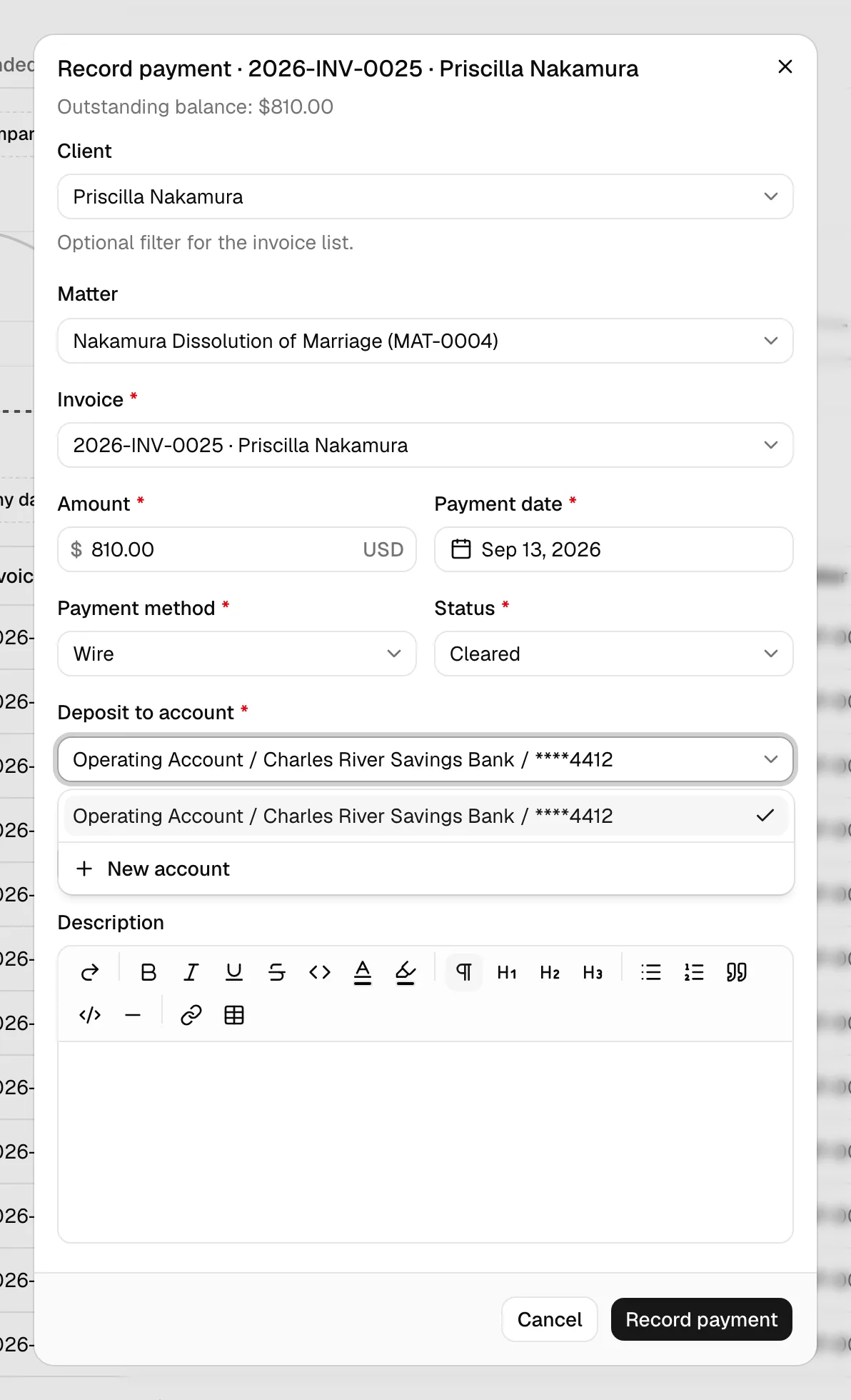
- Pick the Invoice. Type in the field to search every open invoice by invoice number or client name. Client and Matter sit above it as optional filters (Any client, Any matter) to narrow the search; you do not have to set either, which is what lets you find a consolidated invoice that has no matter. If you opened the dialog from a specific invoice, it is already filled in and locked.
- Enter the Amount. Nothing is prefilled, so the figure on a payment is always one somebody typed on purpose. The dialog shows the invoice's outstanding balance for reference.
- Set the Payment date. It defaults to today.
- Choose the Payment method: Wire, Check, Cash, Credit Card, Trust / Escrow Transfer, or Other. (Pick Trust / Escrow Transfer only for the trust-transfer flow described below.)
- Set the Status:
- Cleared (the default) records the payment as received and immediately reduces the invoice balance.
- Pending records the payment but waits to apply it to the invoice until you mark it cleared (useful for a check that has not cleared the bank yet).
- Failed records a payment that did not go through.
- Under Deposit to account, pick the operating or savings account the money lands in. To create a new account without leaving the form, click New account at the bottom of the list.
- Optionally fill in the Payer (who actually paid), a Check or reference no., and a Description with any notes.
- Click Record payment.
When you save, Esqase records the payment, deposits the amount into the chosen account, updates the invoice (to Partially paid or Paid if the payment cleared), and writes an entry to the account ledger. You will see a "Payment recorded" confirmation.
Tip: You can also start this flow straight from an invoice. On the Invoices list, open a row's actions and click Record payment, or use Record payment on the invoice's detail page. The client, matter, and invoice are pre-selected for you.
Record a payment with overpayment parked in a trust account
Sometimes a client pays more than the invoice owes (for example, a round-number retainer check). Esqase applies what the invoice needs and parks the extra in a trust account as client credit, so the surplus is held safely instead of inflating the invoice.
- Start a payment as described above, with the Payment method set to anything other than Trust / Escrow Transfer.
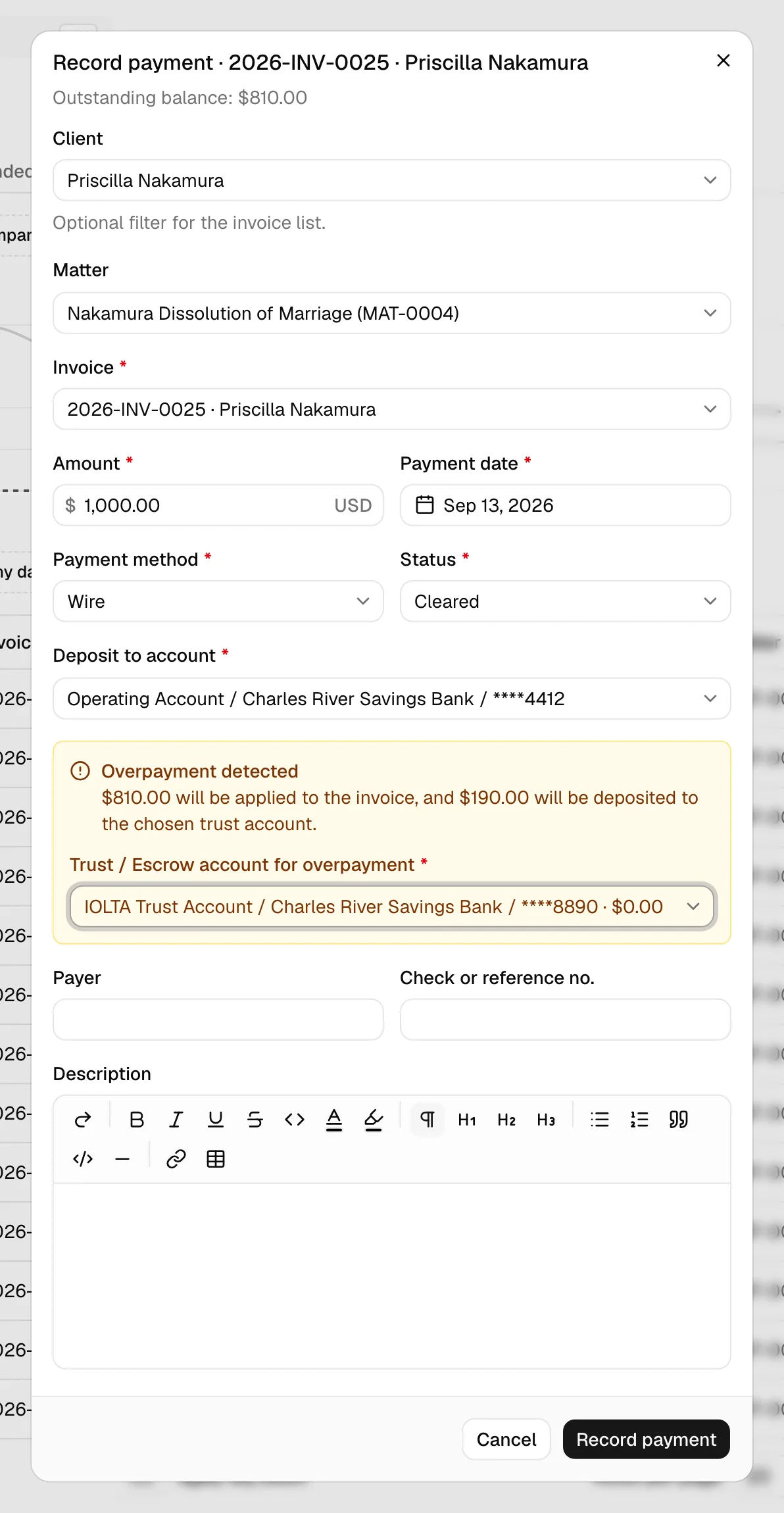
- In the Amount field, enter a figure larger than the invoice's outstanding balance.
- An Overpayment detected notice appears, telling you exactly how much will be applied to the invoice and how much will be deposited to trust.
- In the Trust / Escrow account for overpayment field that appears inside the notice, pick the trust account that will hold the surplus.
- Finish the rest of the form (date, method, deposit account for the applied portion, optional payer/reference/notes) and click Record payment.
On save, the invoice is paid in full from the applied portion, the deposit account receives that portion, and the overpayment is deposited into the chosen trust account. In the payments list, the Remarks column will show the amount routed "to trust."
Important: You must choose a trust account for the overpayment. If you leave it blank, the form will not let you save and will prompt you to "Pick a trust account to hold the overpayment."
Record a trust-transfer payment (pay an invoice from trust funds)
When a client already has money sitting in trust (for example, a retainer you collected earlier), you can move some of those funds to your operating account to pay an invoice. This is a trust transfer: the firm earns the fee and the client's trust balance goes down by the same amount.
- Start a payment and select the invoice as usual.
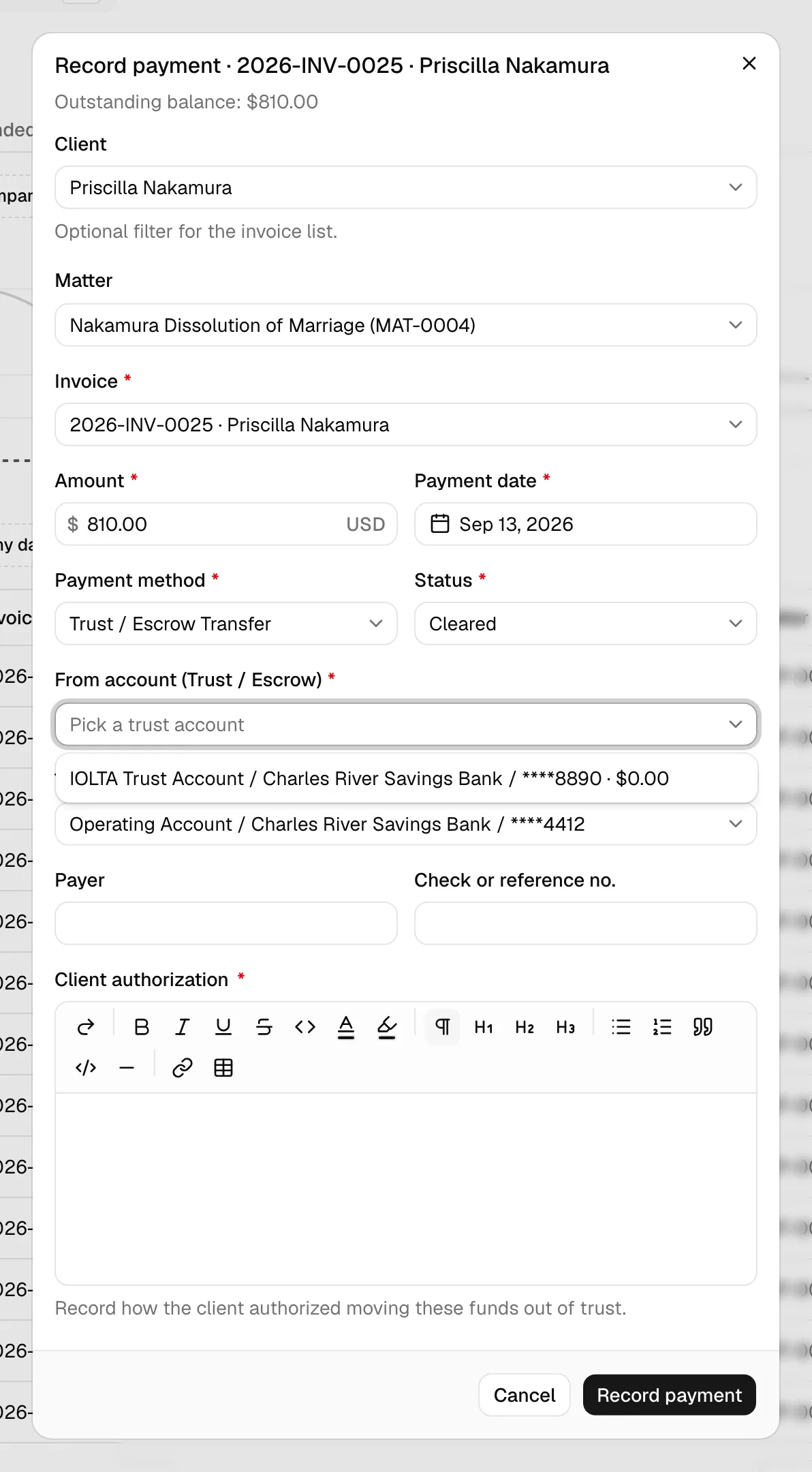
- Set the Payment method to Trust / Escrow Transfer. The account fields change to two pickers.
- In From account (Trust / Escrow), pick the trust account to draw from. Each option shows the client's current available balance in that account, so you can see what is available before you transfer.
- In To account (Operating / Savings), pick the operating account that will receive the funds.
- Enter the Amount to transfer. For a trust transfer, the amount cannot be more than the invoice's outstanding balance.
- Set the date, optional payer/reference/notes, and click Record payment.
On save, Esqase moves the funds out of the trust account and into the operating account, applies the payment to the invoice, and updates both account ledgers.
Important: The amount cannot exceed the client's available trust balance in the chosen account. If it does, an Insufficient trust balance message appears telling you how much is available, and the form will block the save. Lower the amount or pick a different trust account.
Note: The From and To accounts must be different accounts.
Mark a pending payment as cleared
A Pending payment is recorded but has not yet been applied to the invoice. This covers a check you are waiting to clear the bank, and every payment a client reports on a payment link. When the funds arrive, mark it cleared so the invoice balance updates.
- On the Payments list, find the pending payment. Pending rows show a Review button in the actions column.
- Click Review.
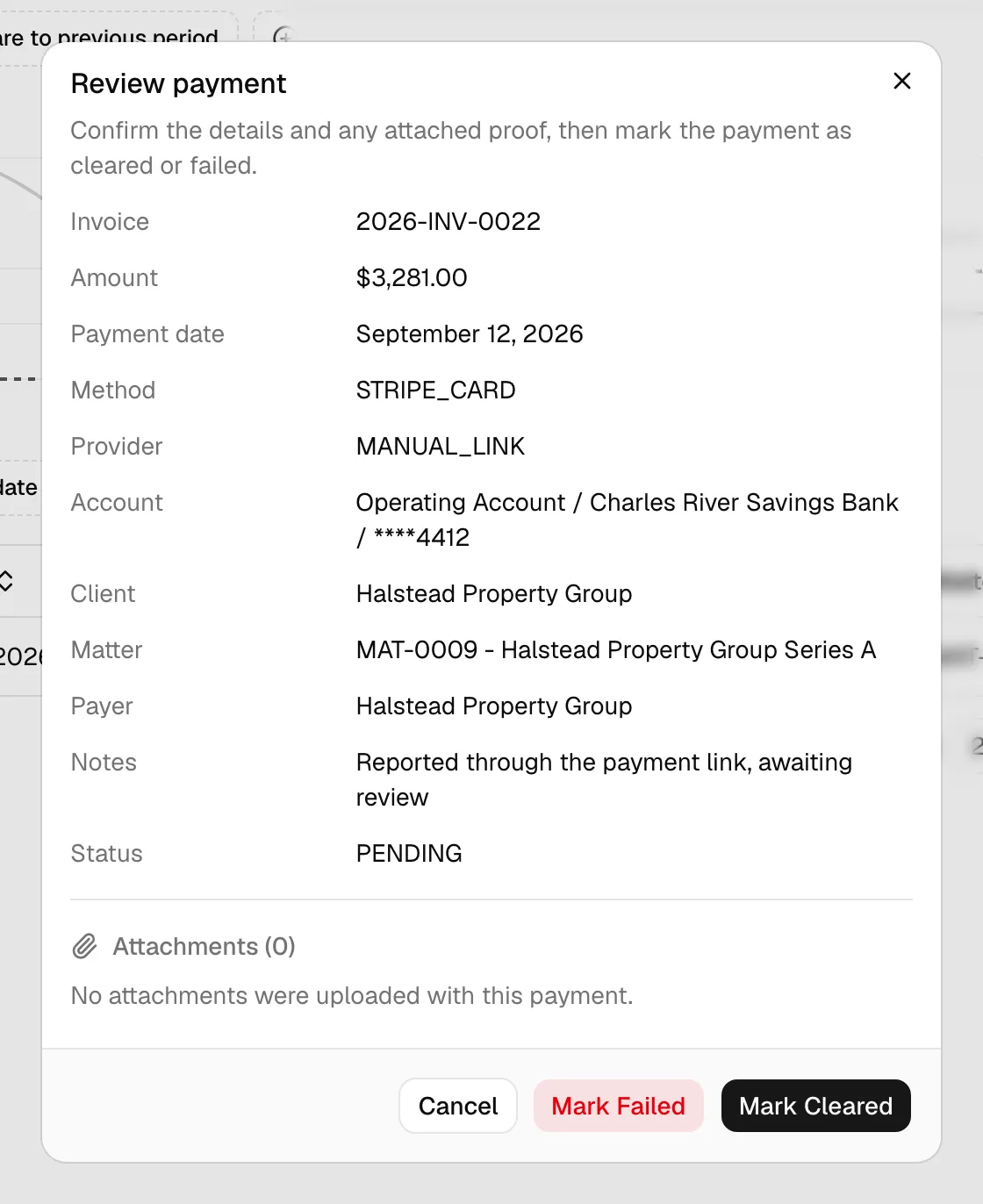
- In the Review payment dialog, confirm the details (amount, date, method, account, client, matter) and check any attached proof of payment.
- Click Mark Cleared.
The payment becomes Cleared, the deposit posts to the account ledger, and the invoice moves to Partially paid or Paid. You will see a "Payment cleared" confirmation.
If the payment did not go through after all, click Mark Failed in the same dialog instead. The payment is recorded as Failed and never touches the invoice balance.
Change a payment status
You can adjust the status of a payment that has not yet been applied or refunded directly from the list, without reopening the full form.
- On the Payments list, find the payment in the Status column.
- If the status is Pending or Failed, it shows as a clickable badge. Click it.
- Choose the new status from the menu (Pending or Failed).
The status updates in place and a "Payment status updated" confirmation appears.
Note: Only Pending and Failed payments can be switched this way. To move a pending payment to Cleared, use the Review flow above (this is what actually applies the money to the invoice). Cleared, Refunded, Voided, and Archived statuses are shown as read-only badges and cannot be changed inline; to reverse a cleared payment, issue a refund instead.
View a payment's details
Every payment, regardless of status, has a read-only details view.
- On the Payments list, click View in the actions column of any row.
- The Payment details dialog opens, showing the invoice, amount, payment date, method, status, the account it landed in (or the From and To accounts for a trust transfer), payer, reference number, and description.
- If the payment included an overpayment, the dialog also shows the Applied to invoice amount, the amount Held in trust, and the Overpayment trust account.
- Click Close when you are done.
Tip: The View action is always available, even when a payment is cleared, refunded, or archived. The Review button (for clearing) and the Refund action only appear when they apply to that payment's status.
Refund a cleared payment
You can refund a payment once it is Cleared. A refund can go back to the client out of your operating account, or be held as client credit by depositing it into a trust account. Refunds can be full or partial.
Important: Refunding is its own permission, shown as Payment refunds in the role grid, separate from ordinary payment editing. It is off by default for attorneys and staff, because a refund moves money out of the firm and cannot be undone. Grant it deliberately. See Roles and permissions.
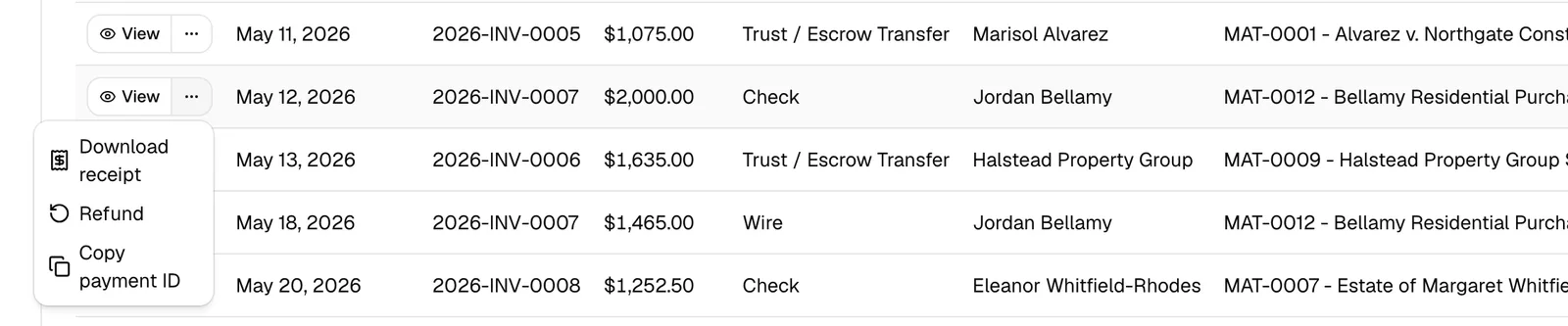
- On the Payments list, open the actions menu (the ... button) on a cleared payment.
- Click Refund.
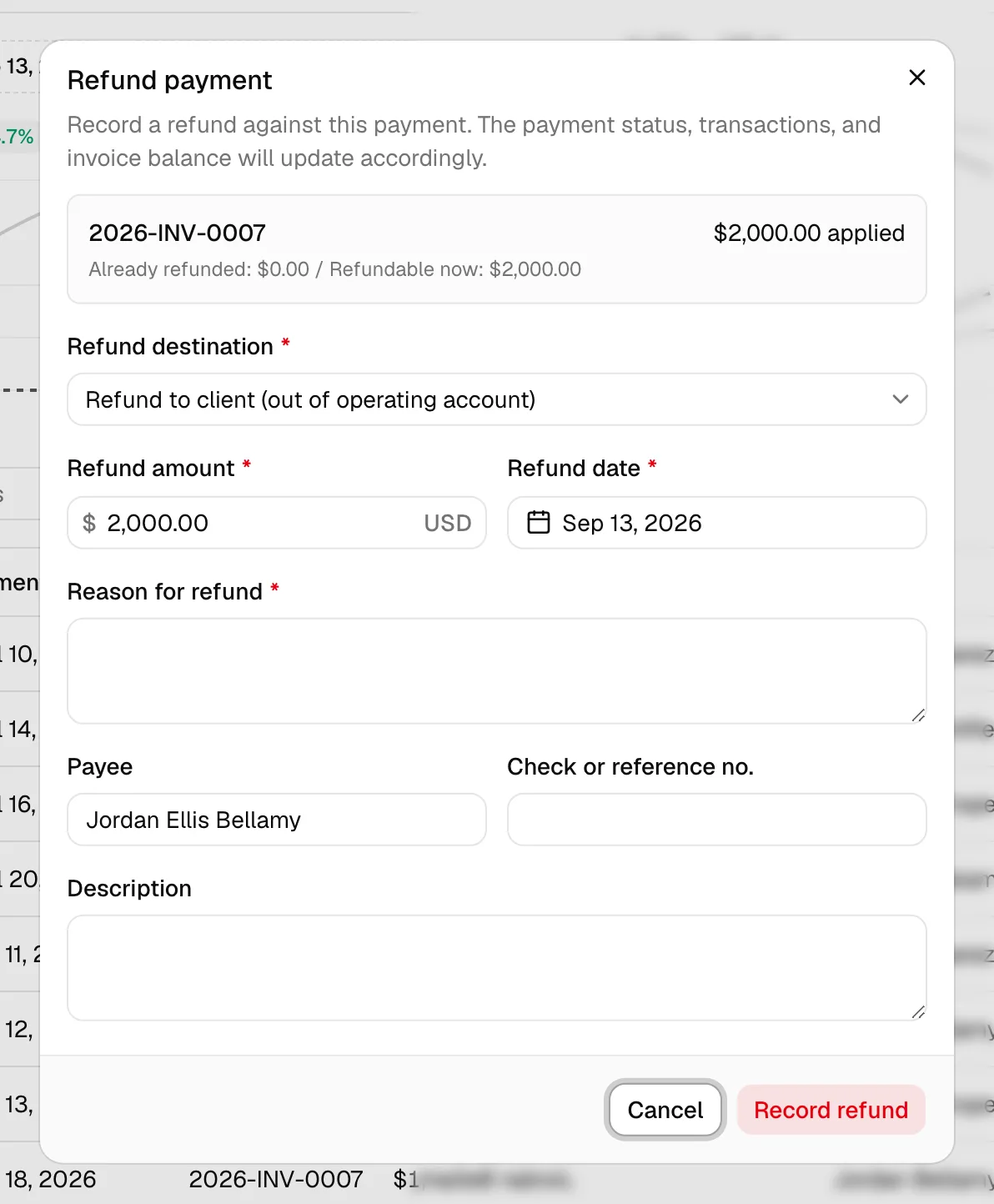
- In the Refund payment dialog, the top summary shows how much was originally applied, how much has already been refunded, and how much is refundable now.
- Choose the Refund destination:
- Refund to client (out of operating account) sends money back to the client and reduces your operating account balance.
- Hold as client credit (deposit to trust) keeps the money for the client by depositing it into a trust account. If you pick this, a Trust account field appears so you can choose which one.
- For a payment that was itself a trust transfer, the default is Return to ... (Trust), which puts the money back into the client's original trust account, with the operating refund offered as the alternative.
- Enter the Refund amount. It defaults to the full refundable balance; lower it for a partial refund. You cannot exceed the refundable balance, and the form warns you if you try.
- Set the Refund date.
- Fill in Reason for refund. This is required, and has to be at least a few words. It is what the audit trail carries, and what the next person reads when they ask why the money went back.
- Optionally add a Payee, a Check or reference no., and a Description.
- Click Record refund.
On save, Esqase records the refund, adjusts the account ledger (and the trust account if you chose to hold credit), and updates the invoice balance. A full refund sets the payment's status to Refunded; a partial refund leaves the payment cleared but reduces how much is still refundable.
Important: Only money that actually left your operating account is refundable. A trust transfer moves funds between your own accounts and is net-neutral, so for that case the natural destination is returning the funds to the original trust account.
Refund to the operating account or into a trust account
The two destinations behave differently, so pick the one that matches what you mean to do.
- Refund to client (out of operating account): Choose this when you are actually returning the client's money. It decreases your operating account balance by the refund amount.
- Hold as client credit (deposit to trust): Choose this when the client should keep a balance with the firm rather than receive cash back. The refund amount is deposited into the trust account you select and stays available for future invoices.
Browse, search, filter, and sort the payments list
The Payments page lists every payment your firm has recorded. Use the controls along the top to narrow it down.
- In the sidebar, click Payments.
- Use the status tabs above the table to filter by state: All, Pending, Cleared, Failed, or Refunded.
- Use the toolbar to refine further:
- Search payments matches by client, invoice, reference, and related details.
- The date range filter limits the list to payments whose payment date falls in the range you pick.
- The Method filter lets you show only certain payment methods (Wire, Check, Cash, Credit Card, Stripe Card, PayPal, Trust / Escrow Transfer, Other). Stripe Card and PayPal are kept so older payments stay findable; you cannot choose either when you record a new payment.
- When any filter is active, a Clear filters button appears to reset everything.
- Sort by clicking a column header. You can sort by Payment date, Amount, or Last updated.
- The table columns are Actions, Payment date, Invoice, Amount, Method, Client, Matter, Status, Remarks (shows overpayments routed to trust), Updated by, and Last updated. Use the view options menu to show or hide columns, and the refresh control to reload the latest data.
- Four of those columns are links: Invoice opens the invoice, Client opens the contact, Matter opens the matter (shown as its reference number and title, for example
MAT-0042 - Smith v. Acme Corp), and the name in Updated by opens that member's page. Clicking a link opens the record you clicked rather than the payment; use the row's View button to open the payment itself.
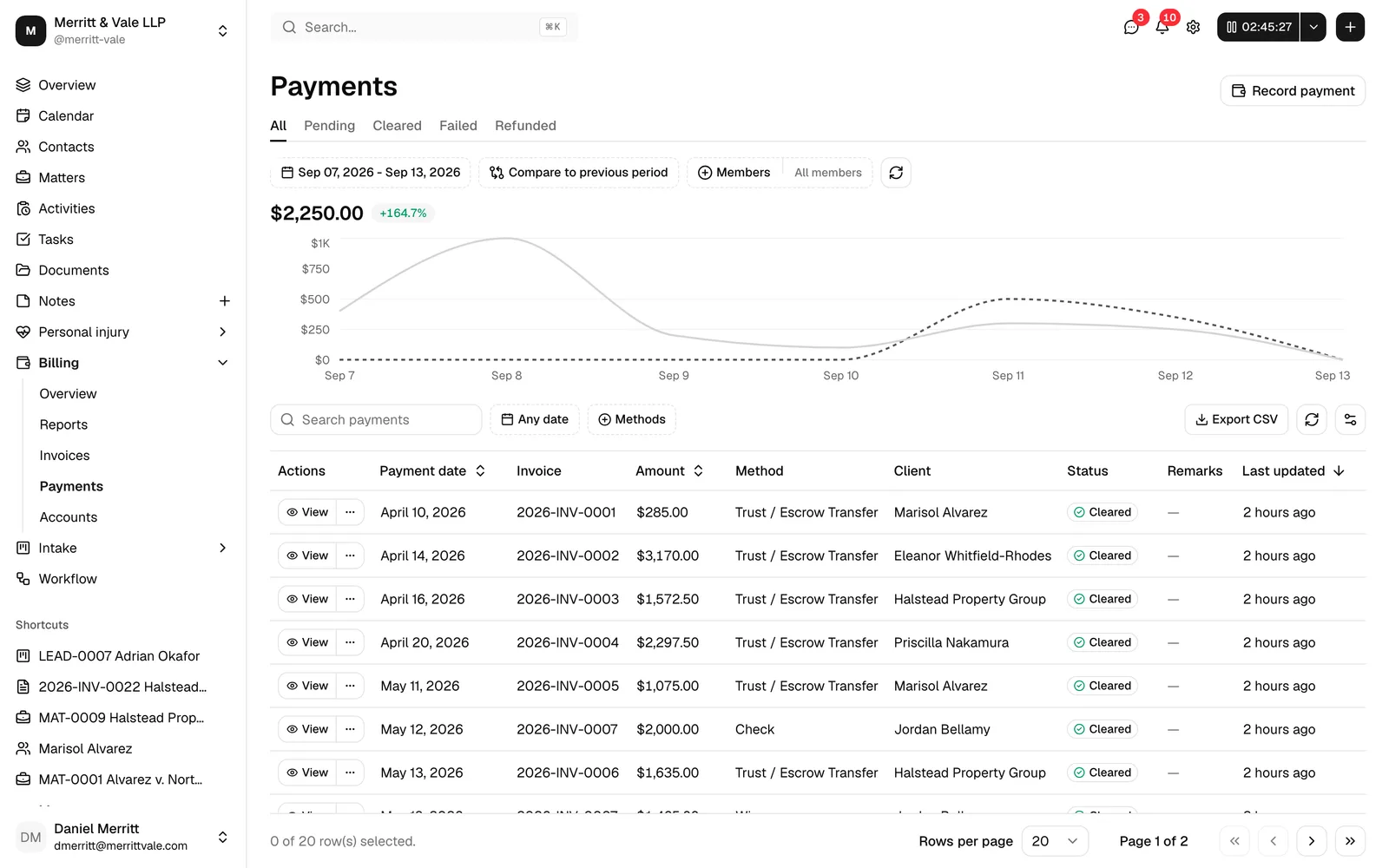
Tip: The Invoice column links straight to the invoice. Click it to open the invoice and see the full picture of what is billed, paid, and outstanding. See Creating and sending invoices. For the whole set of links built into list rows, see Navigating the dashboard.
Read the payments trend chart and the date-range filter
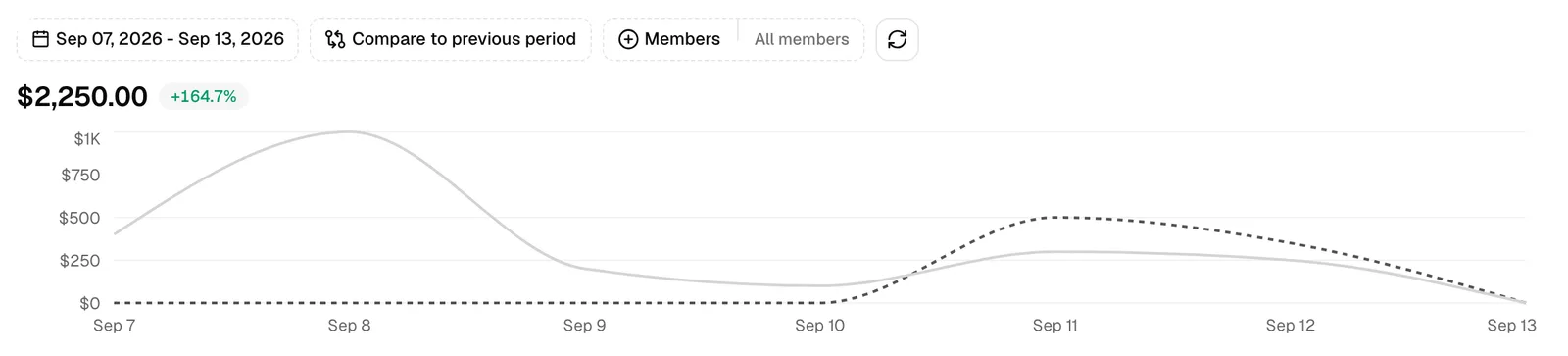
Above the table sits a payments trend chart that shows your cleared payment volume over time, with an optional comparison against a previous period. Its filter controls run across the top of the chart, and the period total sits just below them.
- The headline figure is the total payments collected for the selected period, with a percentage badge showing the change versus the comparison period (green for up, red for down).
- The date range control, in the filter row at the top of the chart, sets the period the chart covers. This is separate from the date filter on the table below.
- The comparison control lets you compare the selected period against the Previous period (the equally long stretch immediately before it) or a custom range you choose. The dashed line is the comparison period; the solid line is the current one.
- The member filter narrows the chart to payments tied to specific firm members.
- The refresh control reloads the chart with the latest figures.
Note: The trend chart reflects cleared payment activity. Pending and failed payments do not contribute to the totals.
For a firm-wide view of revenue, outstanding balances, and collections, see The billing overview dashboard.
Download a payment receipt
Every cleared payment can produce a receipt PDF for the client.
- On the Payments list, open the ... menu on a cleared payment.
- Click Download receipt.
- The PDF downloads. It carries your firm's name, address, and contact details, who the money was received from, the amount, the payment date and method, the invoice it was applied to, the account it was deposited to, and the matter where there is one.
If your firm has switched on official receipt numbering, the document is titled OFFICIAL RECEIPT and carries its receipt number, taken from the firm's receipt sequence when the payment cleared. Without that setting it is titled PAYMENT RECEIPT and is referenced by the payment instead. See Invoice and billing settings.
Note: Download receipt only appears on a Cleared payment. A pending payment has not been received yet, so there is nothing to receipt.
Attach a receipt or proof of payment
Payments can carry attached files, such as a scanned check, a wire confirmation, or a receipt, so the proof lives alongside the record.
- On the Payments list, click Review on a pending payment (or View on any payment).
- In the Attachments section, you will see any files already attached to the payment.
- For each attachment, use the preview control (the eye icon) to open it in a new tab, or the download control to save a copy.
Many attachments arrive on their own: when a client attaches proof of payment while reporting a payment on a payment link, that file is saved with the payment for you. Accepted file types are PDF, PNG, JPG, WebP, and GIF, up to 25 MB each.
Note: Attachments are previewed and downloaded through the Review payment dialog. If a payment has no files, the section reads "No attachments were uploaded with this payment."
Common questions
- Why didn't recording a payment change the invoice balance? The payment was probably saved as Pending. Only Cleared payments reduce the invoice balance. Use Review then Mark Cleared to apply it.
- Why can't I record a payment against this invoice? The invoice must be open, partially paid, or paid to accept money. Draft and cancelled invoices cannot. Open the invoice to check its state. If the state looks right, check the approval panel at the top right of the invoice: an open review blocks payments until it is approved. See Approvals for invoices and documents.
- I don't see a Refund option on a payment. Refunds are only available on Cleared payments. Pending, failed, refunded, and archived payments cannot be refunded.
- Why is the Record payment button missing? Your role does not include Create access for payments. Ask a firm owner or administrator to adjust your role. See Roles and permissions.
- The Refund action is missing even though the payment is cleared. Refunding is a separate grant (Payment refunds) that is off by default for attorneys and staff. Ask a firm owner or administrator to grant it.
- A payment shows "Restricted matter" instead of the matter name. That payment belongs to a matter whose visibility is limited to specific members, and you are not one of them. You can still see and clear the payment; only the matter's identity is hidden. See Roles and permissions.
Related
- Creating and sending invoices
- Approvals for invoices and documents
- Accounts, trust, and transactions
- Payment settings
- Invoice and billing settings
- Trust compliance and three-way reconciliation
- Financial reports and exports
- The billing overview dashboard
- How clients pay invoices
- Roles and permissions