Integrations overview
Esqase connects to a handful of outside services so you can send email, sync your calendar, create meeting links, keep a folder of your documents in step with OneDrive or Google Drive, take card and bank payments through LawPay or Confido Legal, send your billing to QuickBooks Online or Xero, and keep your firm subscription active, all without leaving the app. This page explains what Esqase connects to, why each connection exists, who controls it, and where to set it up.
There are two kinds of connections in Esqase, and the difference matters:
- Personal connections are tied to your own user account. Linking your own email, calendar, and meeting accounts is the clearest example: email you send comes from you, and meetings you book use your accounts. Each member links (or skips) these on their own, and your choices do not affect anyone else at the firm.
- Firm-wide connections are shared by everyone at the firm. Payment settings, your payment processor (LawPay or Confido Legal), accounting sync (QuickBooks Online or Xero), and your Esqase subscription work this way: they are configured once for the whole firm, usually by a firm owner, and they apply to every member.
Before you begin
- To link your own accounts (email, calendar, meetings), you only need to be a signed-in member. No special role is required, because these links are personal to you.
- To change firm payment settings, you need to be a firm owner or have View access to the firm payment settings. If you do not, the Payments page will be read-only or hidden.
- To connect LawPay or Confido Legal for your firm, you need to be a firm owner or have Update access for Firm payment settings (owners and administrators have it by default).
- To connect QuickBooks Online or Xero for your firm, you need to be a firm owner or have Update access for Accounting sync settings (owners and administrators have it by default).
- To sync a folder with your own Microsoft OneDrive or Google Drive, you need View and Create access for documents, because the synced files live in your documents.
- To change your firm subscription (plan, payment method, or cancellation), you must be a firm owner.
- Some firm-wide connections (email delivery, file storage, and push notifications) are handled automatically by Esqase. There is nothing to set up for those, and they are described below so you know what is happening behind the scenes.
Your personal integrations
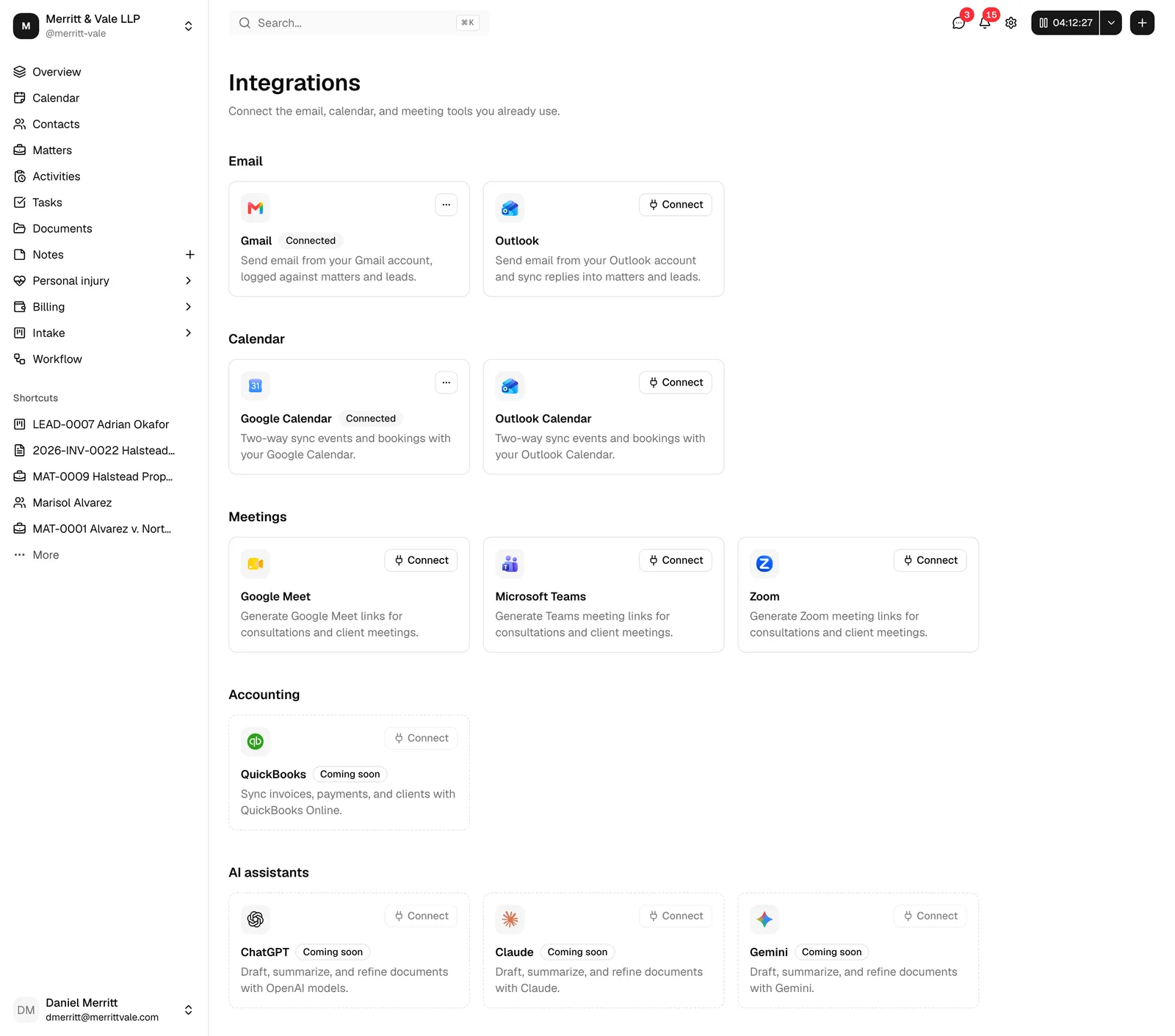
Esqase now gathers all of your personal connections on one Integrations page, so you can connect the email, calendar, and meeting tools you already use in a single place. The same page is where your firm connects its payment processor and its accounting software, the two firm-wide connections there.
- In the sidebar, click Integrations. (You can also reach the same page from Settings.)
- The page is grouped into categories, each with one card per provider:
- Email: Gmail and Outlook. Connecting one lets you send email from that account inside Esqase, and every message you send is logged on the matter or lead it belongs to, against the mailbox it actually went out from. Outlook also brings replies back into that record automatically. The Gmail connection is send-only, so Esqase does not read your Gmail mailbox and you log Gmail replies yourself.
- Calendar: Google Calendar and Outlook Calendar. Connecting a calendar keeps your Esqase events and that calendar in step, two ways.
- Meetings: Google Meet, Microsoft Teams, and Zoom. Connecting one lets Esqase generate a video meeting link when you schedule a meeting.
- Cloud storage: Microsoft OneDrive and Google Drive. Connecting one lets you keep one folder in that drive in step with your Esqase documents, both ways, create Word documents or Google Docs from Esqase, and convert Office files to PDF for signature. This connection is personal too (see Connecting OneDrive and Google Drive).
- Payments: LawPay and Confido Legal. This connection is firm-wide: one connection lets your clients pay any payment link by card or bank account, and Esqase records those payments by itself (see Taking payments below).
- Accounting: QuickBooks and Xero. This connection is firm-wide too: one connection sends your whole firm's clients, invoices, payments, and credit notes to QuickBooks Online or Xero (see Accounting sync below).
- AI assistants: ChatGPT, Claude, and Gemini. These are shown as Coming soon and are not available to connect yet (see below).
- Each active card shows a Connect button when the account is not connected. Once it is connected, the card shows a Connected badge and a more options (⋯) menu, which lists the connected account and a Disconnect action.
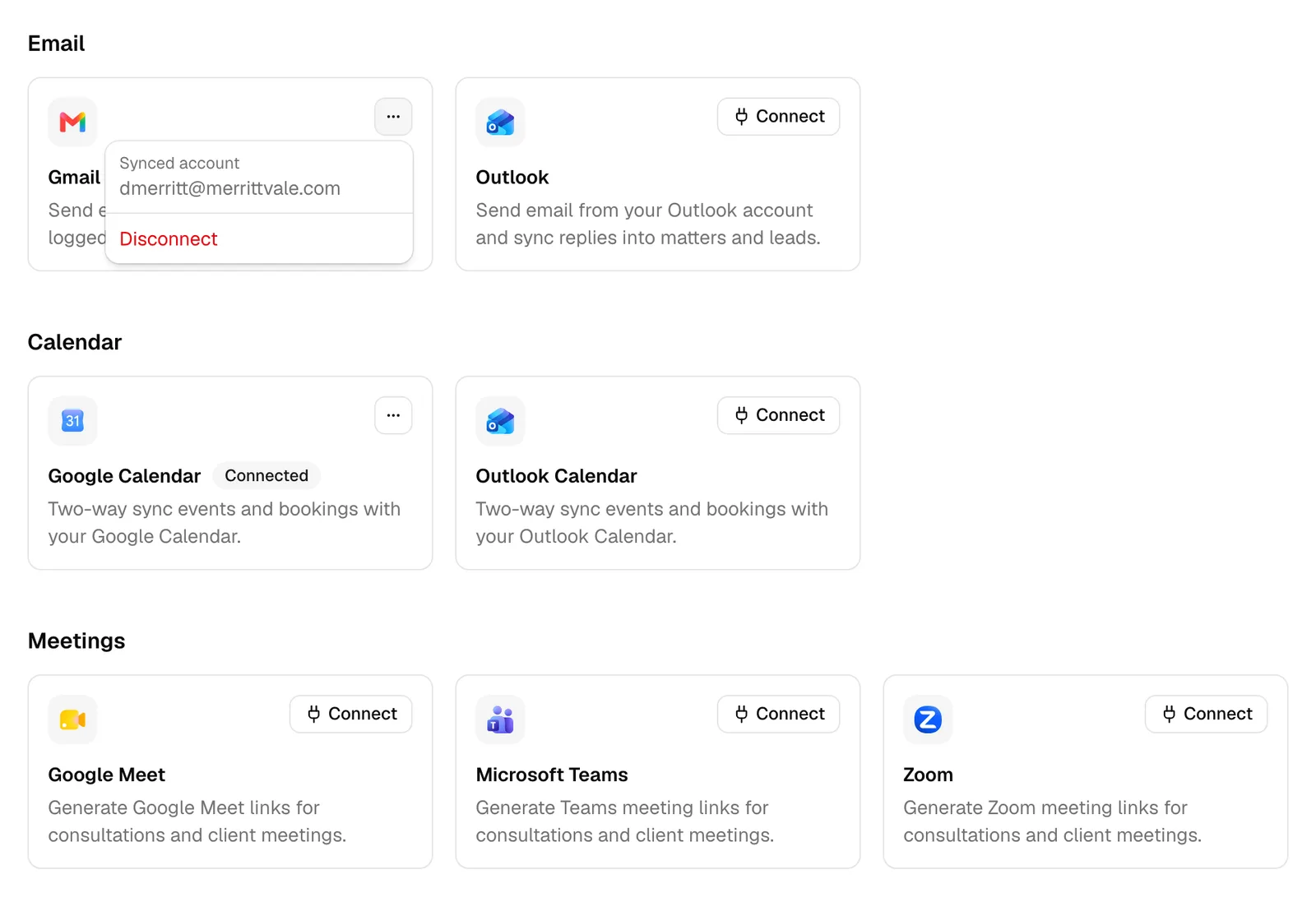
Note: Every connection is its own card. Connecting Gmail does not connect your Google Calendar or Google Meet, and connecting Outlook does not connect Outlook Calendar. Connect each tool you want to use.
Connecting an account
- On the card you want, click Connect.
- On the Gmail, Google Calendar, and Google Meet cards, a dialog opens first and explains what Esqase will ask Google for and what it uses it for, with a link to the Privacy Policy. Read it, then click Continue to Google (or Cancel to stop). The LawPay and Confido Legal cards open a similar dialog with Continue to LawPay or Continue to Confido, the QuickBooks and Xero cards with Continue to Intuit or Continue to Xero, and the Microsoft OneDrive and Google Drive cards with Continue to Microsoft or Continue to Google. The Outlook, Outlook Calendar, Microsoft Teams, and Zoom cards go straight to the provider.
- Esqase sends you to that provider's sign-in and consent screen (Google, Microsoft, or Zoom). Sign in if asked, review what Esqase is allowed to do, and approve. Google lets you untick individual permissions, so keep every one ticked: a Google connection that is missing the permission it needs is refused, and Esqase asks you to connect again.
- When you return, the card shows a Connected badge. To see which account is connected or to stop using a connection, open the card's more options (⋯) menu, which shows the connected account and a Disconnect action. Disconnecting revokes Esqase's access to that service and clears the credentials it had stored, and past emails and existing events stay in place, but Esqase can no longer send new email, sync new events, or create new meeting links through that connection until you connect it again.
Note: After you connect Microsoft OneDrive or Google Drive, Esqase takes you to Settings > Cloud storage to choose the folder to sync, and nothing syncs until you do. The connected card's menu also offers Cloud storage settings and Sync now. Disconnecting one of these cards stops the folder syncing, and the files already in Esqase and in the drive stay where they are. See Connecting OneDrive and Google Drive.
Tip: Because these connections are personal, every member who needs to send email, sync a calendar, or create meeting links should connect their own accounts. Your connections are not shared with your colleagues, and a matter's other team members do not inherit them.
Choosing which mailbox you send from
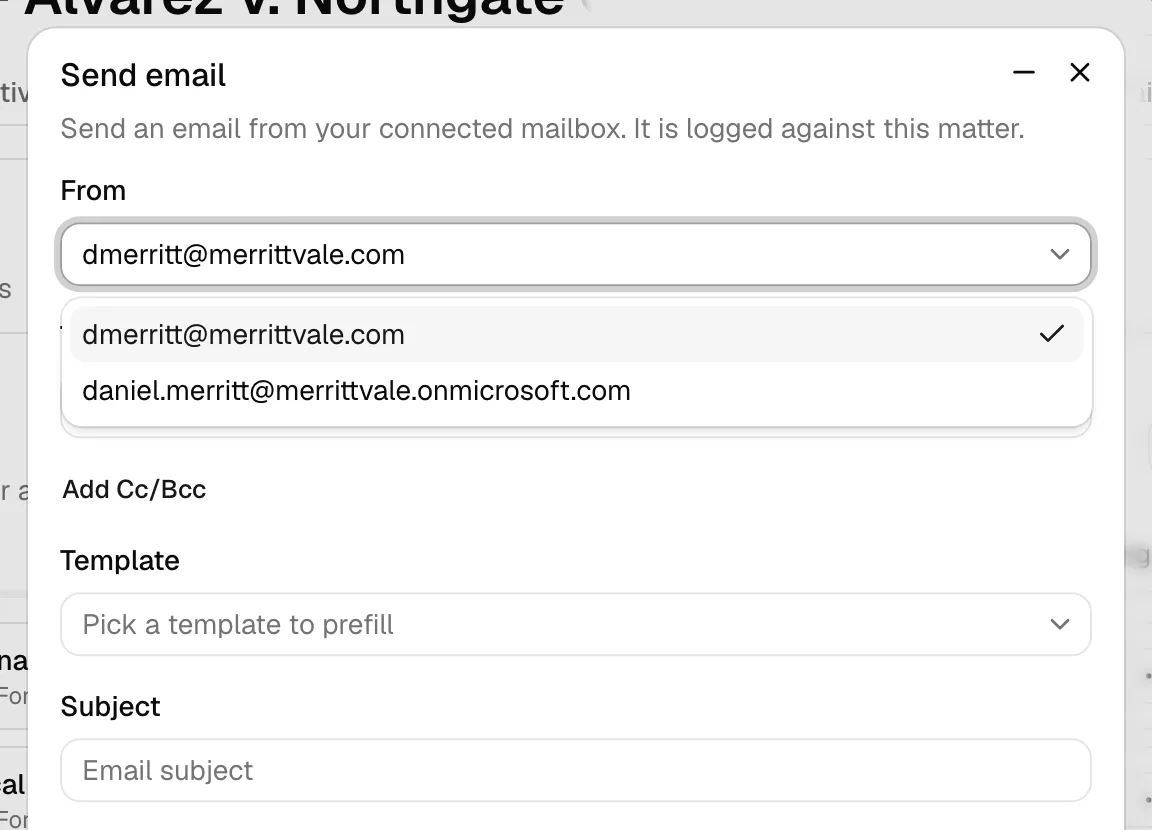
If you connect both Gmail and Outlook, the email composer adds a From picker so you can choose which mailbox a message goes out from. Open the From menu, then select the account (shown by its email address) you want to send as. If only one email account is connected, Esqase simply sends from that account and the From line shows which one.
You can still email without connecting a mailbox
Connecting Gmail or Outlook is not a requirement for writing to a client. The email composer opens whether or not you have a mailbox connected, and the templates, signature, recipients and placeholders all work the same way. What changes is the last step:
- With a mailbox connected, Esqase sends the message for you, records it as sent on the matter or lead, and (through Outlook) threads replies back onto that record.
- With no mailbox connected, the composer shows a No mailbox connected notice, the send button reads Continue, and Esqase hands the finished message to your own mail app (Gmail, Outlook, Yahoo Mail, Proton Mail, AOL Mail, or your computer's default mail app) with the recipients, subject and message filled in. You then choose what to record in Esqase. Because the message leaves in your own mail app, Esqase cannot confirm it was delivered, and anything you log as sent is marked Unverified.
Connecting a mailbox is still the better experience, and it is the only way to have delivery and replies recorded for you.
See Sending email for how outgoing client email is composed, and Calendar and events for how synced events behave.
Coming soon: AI assistants
The AI assistants group lists ChatGPT, Claude, and Gemini as placeholders for future document-assistance features (drafting, summarizing, and refining documents). Every card in this group is marked Coming soon, its Connect button is disabled, and there is nothing to set up yet. They will become connectable in a later release.
Provider walkthroughs
- For the full Google walkthrough (Gmail, Google Calendar, Google Meet), including what each permission covers, see Connecting Google (Gmail, Calendar, Meet).
- For connecting Outlook (email and calendar), Zoom, and Microsoft Teams, including choosing which mailbox to send from and generating meeting links, see Connecting Outlook and Zoom.
- For syncing a folder with Microsoft OneDrive or Google Drive, creating Word documents and Google Docs from Esqase, and converting Office files to PDF, see Connecting OneDrive and Google Drive.
- For connecting your firm's payment processor, mapping its bank accounts, and the card, bank, and autopay switches, see Taking card and bank payments with LawPay or Confido Legal.
- For connecting your firm's accounting software, mapping accounts and taxes, and reading the sync history, see Connecting QuickBooks Online or Xero.
Taking payments (firm-wide)
Client payment options are configured once for your whole firm so clients can pay invoices and so payments land in the right account. This is a firm-wide setting, not a personal one. Your clients can pay a payment link in two ways:
- Card and bank account, through a payment processor. Your firm connects its own LawPay or Confido Legal account, once, on the Integrations page under Payments. Clients then pay by card or straight from their bank account in the processor's secure fields, the money goes to your bank, and Esqase records each payment on the invoice by itself, as soon as the processor reports it.
- Bank transfer or QR code, self-reported. The client pays you through their own bank or payment app using a manual link or QR code you set up, reports the payment on the page, and a firm member confirms it afterwards.
To connect a payment processor:
- In the sidebar, click Integrations.
- Under Payments, click Connect on the LawPay or Confido Legal card, read the dialog, and click Continue to LawPay or Continue to Confido.
- Sign in and approve. Esqase takes you to the Processor tab of your payment settings, where you map the processor's bank accounts to your Esqase accounts. No card or bank payment is taken until an operating account is mapped.
A firm without a merchant account can instead apply with Sign up with LawPay or Apply with Confido Legal on the Processor tab, and a Confido Legal firm can paste an API token with Add Confido API token. Only one processor can be connected at a time.
📷 Screenshot: The Payments group on the Integrations page, showing a connected LawPay card with its Connected badge and more options menu next to the Confido Legal card.
Everything else lives under your firm settings.
- In the sidebar, open Settings.
- Under Firm, click Payments.
- Use the tabs to control how clients pay and where money is recorded:
- Defaults: choose the default deposit account, which is the account a bank transfer or QR payment is recorded against unless you pick a different one at the time, and the default payment terms. Trust accounts (client funds you hold in escrow, such as an IOLTA account) are never offered as a deposit target here.
- Processor: your LawPay or Confido Legal connection, its account mappings, and its recent activity.
- Autopay: the Card payments, Bank payments, Autopay for payment plans, and Send payment plan emails switches.
- Manual link: turn on a manual payment option and add the instructions or link clients should use to pay you outside the app.
- QR code: upload a QR-code image and instructions so clients can scan to pay.
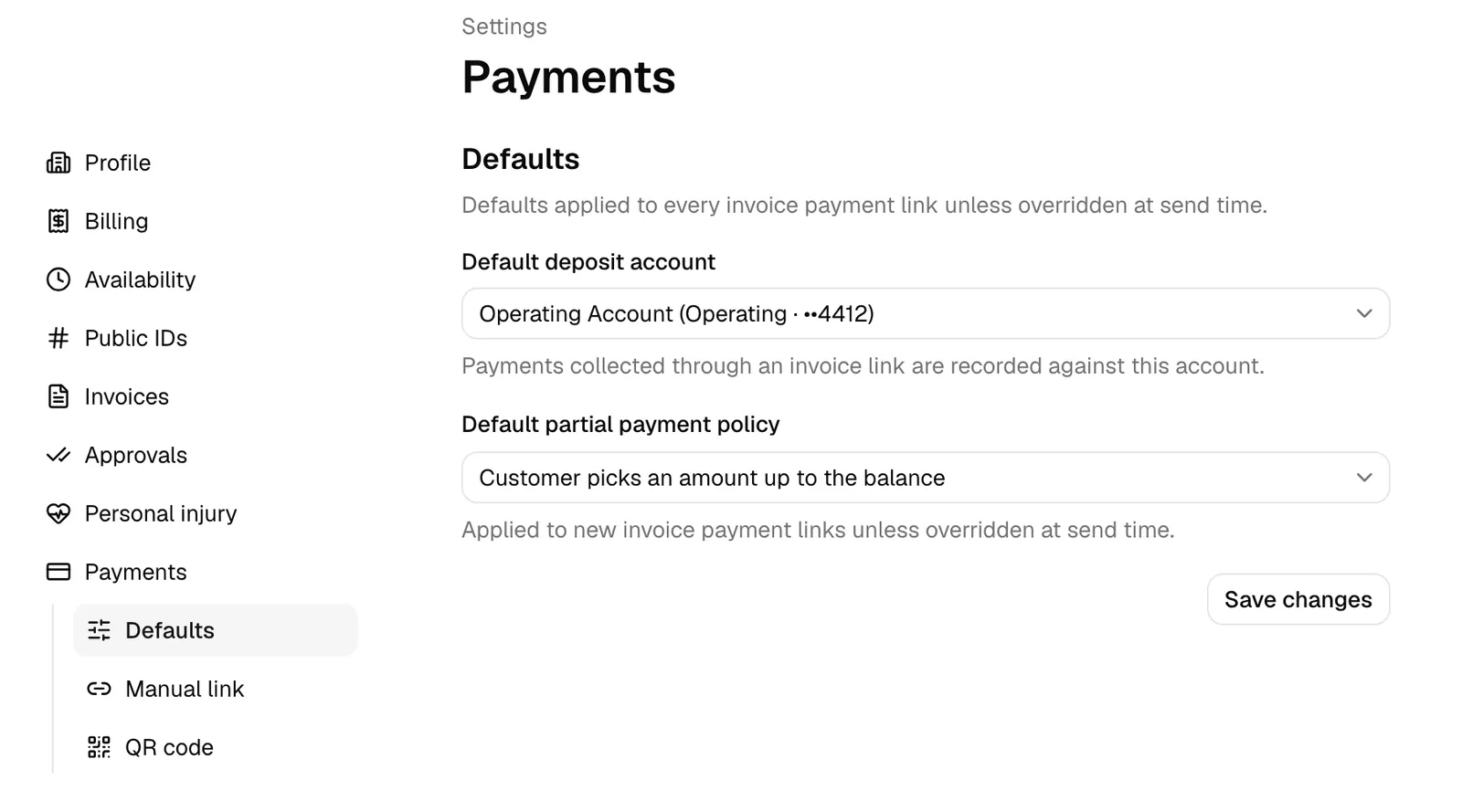
Important: Only firm owners or members with access to Firm payment settings can open this page, and changing it, or connecting a processor, needs Update access. If you do not have access, the page will be read-only or will not appear in your Firm settings.
For the details of each option, see Payment settings and Taking card and bank payments with LawPay or Confido Legal. For installments and autopay, see Payment plans and autopay. To learn how money flows into accounts and how trust funds are kept separate, see Accounts, trust, and transactions. For the client's side of paying, see How clients pay invoices.
Note: Esqase never holds your clients' money. A card or bank payment goes from the processor to your bank under your own merchant account, and Esqase records it. A bank transfer or QR payment arrives in your payments list as Pending and waits for a firm member to mark it cleared.
Accounting sync: QuickBooks Online or Xero (firm-wide)
Your firm can connect QuickBooks Online or Xero so your billing reaches your books without keying it in twice. This is a firm-wide connection: it is made once, by a firm owner or a member whose role includes Update access for Accounting sync settings, and it syncs the whole firm's billing. A firm connects one of the two at a time.
- In the sidebar, click Integrations.
- Under Accounting, click Connect on the QuickBooks or Xero card, read the dialog, and click Continue to Intuit or Continue to Xero.
- Sign in, choose the company or organisation to sync, and approve. If your Xero login reaches more than one organisation, Esqase asks you to choose one.
- Open Settings, then under Firm click Accounting to choose the accounts and tax rates Esqase uses, decide what syncs and from which date, and see the sync history.
Sync runs one way, from Esqase to your accounting software. Esqase sends the clients on your invoices (as customers), finalized invoices, cleared payments, and issued credit notes, automatically as they change and every 15 minutes, and whenever someone clicks Sync now. Nothing is sent until the required accounts are saved in the accounting settings. Drafts and invoices in review stay in Esqase, and nothing you change in QuickBooks or Xero comes back.
Note: Members without access to Accounting sync settings still see the QuickBooks and Xero cards, with a note that only firm owners and administrators can connect accounting software.
For the full walkthrough, including what is not synced yet and how to fix a record that did not go through, see Connecting QuickBooks Online or Xero.
Your firm subscription (firm-wide)
Your Esqase subscription is what keeps the app active for your firm. It is billed at the firm level and managed by a firm owner. This is separate from how your clients pay you: the subscription is your firm paying Esqase, while payment settings (above) are about your clients paying your firm.
- In the sidebar, open Settings.
- Click Billing to view your current plan, billing period, and payment method.
- From here a firm owner can change the plan, update the card on file, or cancel.
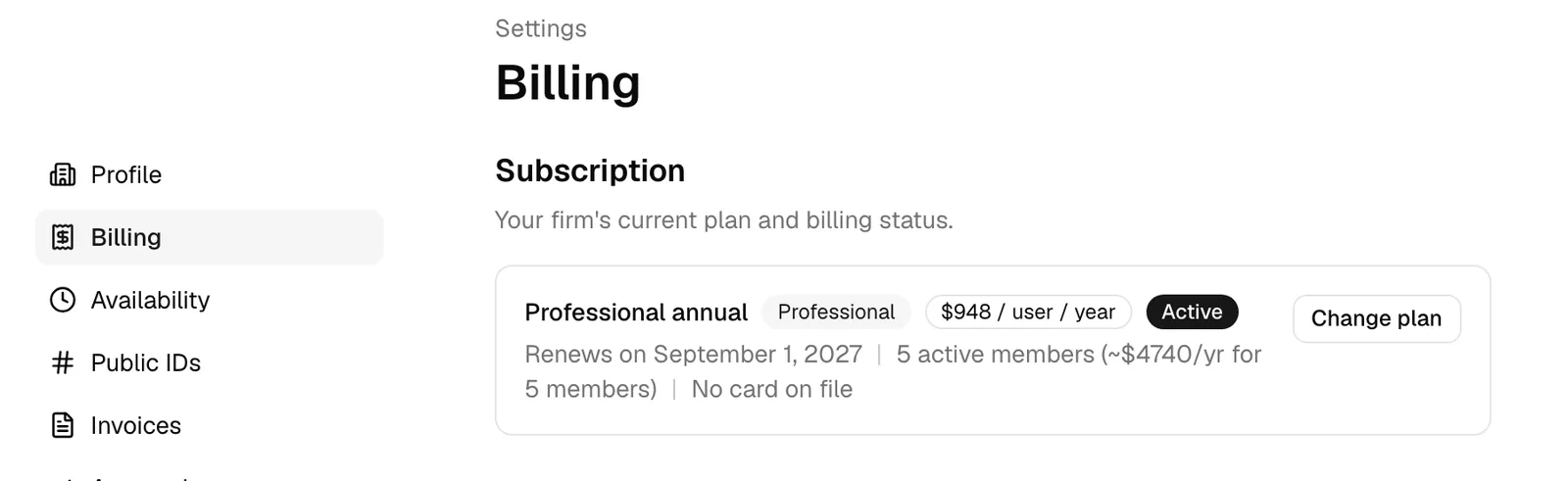
Important: Only firm owners can change the plan, update the payment method, or cancel the subscription. Other members can use Esqase normally but will not see these controls.
For the complete walkthrough, see Your Esqase subscription.
Email delivery (automatic)
Esqase handles two different kinds of email, and it helps to know the difference:
- Email you send to clients (for example, sending an invoice or replying in a matter) goes out through your connected email account (Gmail or Outlook), so it comes from your address. Replies come back to your own inbox. Outlook records them on the matter automatically; the Gmail connection is send-only, so Gmail replies are logged by hand. This is one of the personal connections described above.
- System email from Esqase (for example, an invite to join a firm, a verification email, or a notification) is delivered by Esqase's own email service. You do not set this up, and it works whether or not you have connected Gmail or Outlook.
Note: If you want client-facing email to come from you, connect Gmail or Outlook on your Integrations page. System messages from Esqase itself always arrive regardless.
See Sending email and Email templates for how outgoing client email is composed.
File storage (automatic)
Every file in Esqase (uploaded documents, signed PDFs, payment QR images, profile photos, and attachments) is stored securely in Esqase's managed cloud storage. That storage needs no integration and nothing to configure. When you upload a file, it goes straight to secure storage, and when you download or view one, Esqase serves it through a short-lived private link so only authorized people can open it.
You will mostly encounter storage indirectly, when you upload or download in places like the documents workspace or when attaching a QR-code image to your payment settings. See The documents workspace.
Syncing a folder with OneDrive or Google Drive (personal)
If you also keep files in Microsoft OneDrive or Google Drive, you can connect your own drive under Cloud storage on the Integrations page and choose one folder to keep in step with your Esqase documents. It is optional and personal: each member connects their own drive, and the synced folder sits in your own My documents.
- In the sidebar, click Integrations.
- Under Cloud storage, click Connect on the Microsoft OneDrive or Google Drive card, read the dialog, and click Continue to Microsoft or Continue to Google.
- Approve the access, then choose the folder to sync on the Cloud storage page Esqase opens for you. You can come back to it any time from Settings, in the Personal group.
Files and folders then move both ways: changes in the drive arrive in Esqase within five minutes, or straight away with Sync now, and files you add or change in the synced folder in Esqase go to the drive. Every change from the drive is kept as a new version, and Esqase still stores its own copy of every synced file, as above. Inside the synced folder you can also create a Word document or a Google Doc. Word, Excel, and PowerPoint files can be turned into PDFs with Convert to PDF or Request signature (as PDF): a file in your synced folder through that drive, and any other file through your OneDrive, once a OneDrive folder is syncing.
Note: Google Drive shows Esqase only the files Esqase creates there and the files you add with Add from Google Drive. A file you drop into the folder from Google Drive itself does not appear in Esqase until you add it that way.
For the full walkthrough, including what does not sync, conflicts, trash and restore, and troubleshooting, see Connecting OneDrive and Google Drive.
Push and in-app notifications (personal)
Esqase can let you know when something needs your attention (a new task, an assignment, an upcoming event) in three ways. Which ones you receive is a personal choice, set per notification type.
- In the sidebar, open Settings.
- Under Account, click Notifications.
- For each notification type, turn the delivery channels on or off:
- In-app: the notification appears in the bell inbox inside Esqase, and, while you are working in Esqase, as a message in the corner of the screen.
- Push: the notification also reaches you as a desktop alert while Esqase is in the background. It needs In-app on, so unticking In-app empties and greys out Push.
- Email: Esqase emails you about the event.
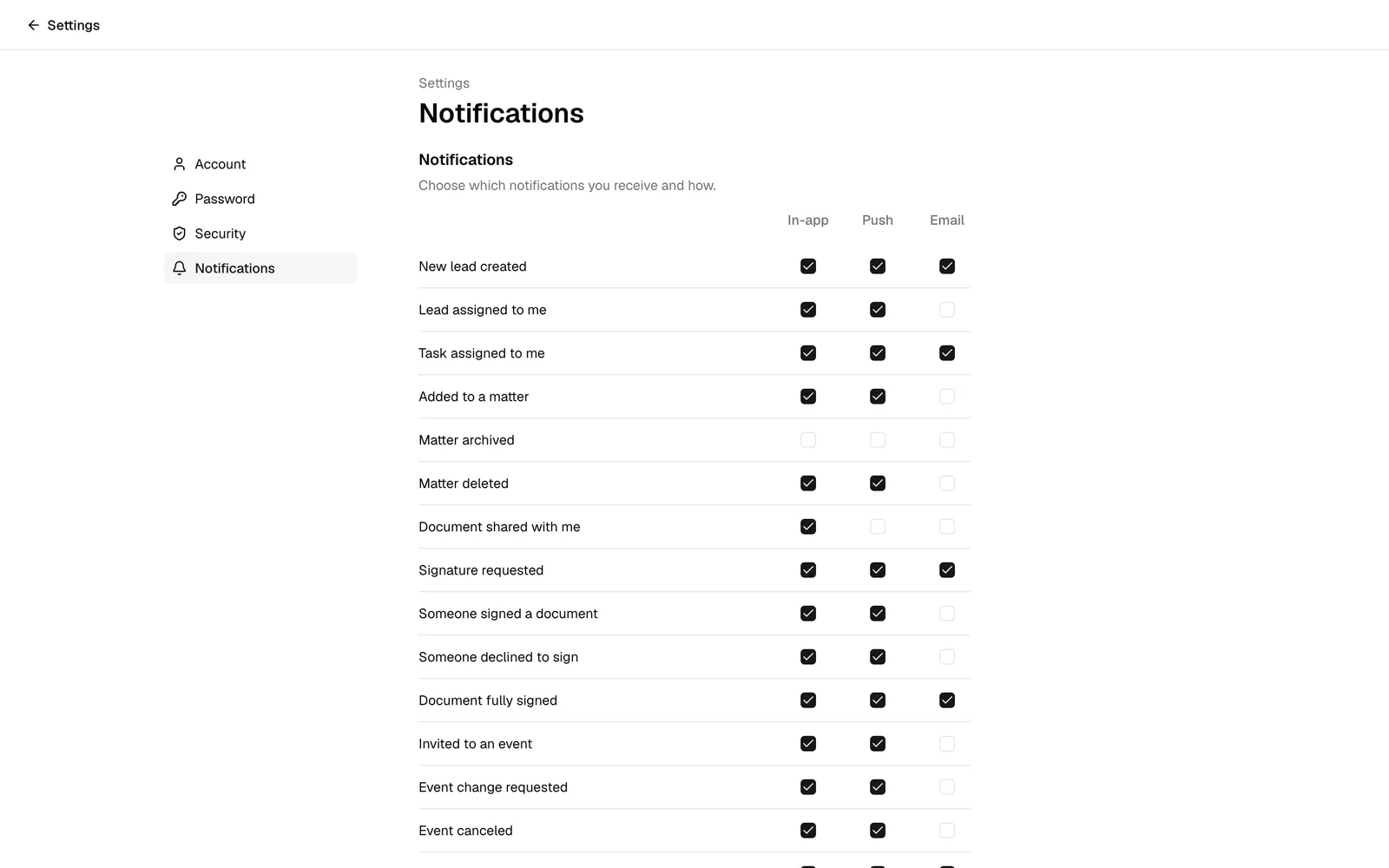
Note: Desktop alerts have to be switched on once per browser, and you do it from the top of this same page: click Enable desktop notifications and answer Allow when your browser asks. Esqase does not ask on its own, because some browsers ignore a request that does not follow a click. See Desktop alerts.
Tip: Notification preferences are personal, like your account connections. Changing yours does not change what your colleagues receive.
For the full breakdown of notification types and how the bell inbox works, see Notifications.
Where each connection lives, at a glance
| Connection | Personal or firm-wide | Where to set it up |
|---|---|---|
| Gmail or Outlook (send email; Outlook also syncs replies) | Personal | Integrations (in the sidebar) |
| Google Calendar or Outlook Calendar (event sync) | Personal | Integrations (in the sidebar) |
| Google Meet, Microsoft Teams, or Zoom (meeting links) | Personal | Integrations (in the sidebar) |
| Microsoft OneDrive or Google Drive (sync one folder with your documents) | Personal | Connect on Integrations, choose the folder at Settings > Account > Cloud storage |
| AI assistants (ChatGPT, Claude, Gemini) | Personal | Integrations (coming soon) |
| Notification delivery (In-app, Push, Email) | Personal | Settings > Account > Notifications |
| Card and bank payments (LawPay or Confido Legal) | Firm-wide | Connect on Integrations, set up at Settings > Firm > Payments (Processor and Autopay tabs) |
| Client payment options (deposit account, bank transfer link, QR code) | Firm-wide | Settings > Firm > Payments |
| Accounting sync (QuickBooks Online or Xero) | Firm-wide | Connect on Integrations, set up at Settings > Firm > Accounting |
| Firm subscription (your firm paying Esqase) | Firm-wide | Settings > Billing |
| System email delivery | Automatic | No setup needed |
| File storage | Automatic | No setup needed (syncing with OneDrive or Google Drive is the optional personal connection above) |
Common questions
- Do I have to connect an email or calendar to use Esqase? No. You can use almost everything without it. You only need to connect Gmail or Outlook if you want to send client email from your own address, a calendar to mirror events on your own schedule, and Google Meet, Microsoft Teams, or Zoom to auto-generate video links.
- Can I connect both Gmail and Outlook? Yes. When both are connected, the email composer shows a From picker so you can choose which mailbox each message sends from.
- My colleague connected their email but I still cannot send. Why? These connections are personal. Each member connects their own accounts, so you need to connect Gmail or Outlook yourself on the Integrations page.
- When can I use the AI assistants? Not yet. ChatGPT, Claude, and Gemini (under AI assistants) appear as Coming soon and are not connectable in this version.
- Can we sync our invoices to QuickBooks or Xero? Yes. A firm owner (or a member with Update access for Accounting sync settings) connects QuickBooks or Xero under Accounting on the Integrations page, once for the whole firm. See Connecting QuickBooks Online or Xero.
- Can I keep working in Word or Google Docs? Yes. Connect Microsoft OneDrive or Google Drive under Cloud storage on the Integrations page and choose a folder: its files and your Esqase documents stay in step both ways, and every change from the drive is kept as a new version. See Connecting OneDrive and Google Drive.
- Who can change payment settings or the subscription? Opening payment settings requires View access to Firm payment settings, and changing them or connecting a processor requires Update access (firm owners have both by default). Subscription changes require a firm owner.
- Can my clients pay me by card through Esqase? Yes, once your firm connects LawPay or Confido Legal under Payments on the Integrations page. Clients can then pay by card or from their bank account, and Esqase records the payment by itself. PayPal is not supported. See Taking card and bank payments with LawPay or Confido Legal and How clients pay invoices.
Related
- Connecting Google (Gmail, Calendar, Meet)
- Connecting Outlook and Zoom
- Connecting OneDrive and Google Drive
- Connecting QuickBooks Online or Xero
- Taking card and bank payments with LawPay or Confido Legal
- Notifications
- Payment settings
- Your Esqase subscription
- Sending email
- Activity timelines and audit logs